

Play for survival and objective XP first. Stars come from staying alive, capping, spotting, and dealing damage from a safe angle, not from chasing kills. Every match, do three things: pick a ship that fits the current meta, check team comp before you commit to a lane, and glance at the minimap every 15 to 20 seconds.
TL;DR:
- Focusing on survivability, objective control, and steady base XP outweighs chasing kills in ranked battles, especially with star-saving mechanics that reward consistent positioning.
- Ship roles matter more than stats in ranked; cruisers and destroyers excel at capping and spotting, while battleships should avoid broadside to prevent easy kills.
- Angling, ammunition discipline, and regular minimap awareness significantly reduce preventable deaths and improve ranking progression more than ship upgrades or crew swaps.
- Timing your grind to start each season's sprint and prioritizing safe play over risky pushes maximizes star retention and overall rank advancement.
- Playing solo and avoiding division reliance emphasizes individual decision-making, which is crucial for climbing in a mode that heavily penalizes unnecessary deaths.
Table of Contents
- The Wows Ranked Guide Checklist Every Match Needs
- How Do Ranked Seasons, Leagues, and Stars Work?
- Which Ships and Roles Actually Win in Ranked?
- What Tactics Actually Move the Needle in Ranked?
- Managing Stars and Planning Your Sprint
- Simple Drills to Track Real Improvement
- Why This Ranked Guide Holds Up
- What Most Ranked Advice Gets Backwards
- Where to Go After This Ranked Guide
- Sources
- FAQ
The Wows Ranked Guide Checklist Every Match Needs
Ranked rewards consistency more than heroics. Run through this checklist before you queue and while the clock runs:
- Before the match: Pick a ship suited to your tier and the current sprint's meta, not just your favorite grind.
- At match start: Scan the team roster on both sides and pick a lane based on who you're likely facing.
- Early game: Position for spotting and early damage without overextending into a 2v1.
- Mid-game: Prioritize staying alive, holding or contesting caps, and stacking base XP over hunting kills.
- Late game: Secure caps you already hold and avoid risky pushes unless the match genuinely needs it.
Pro Tip: If you're unsure whether a push is worth the risk, ask whether losing your ship right now costs your team the cap. If the answer is yes, back off.
This isn't complicated advice, but it's the part most players skip when they're tilted after a loss. A calm, repeatable routine beats a flashy one-off play almost every time in Ranked Battles.
How Do Ranked Seasons, Leagues, and Stars Work?
Ranked Battles run in seasons, each divided into sprints that typically last a short period ranging from about one to a few weeks, each with its own reward track. Progress resets between sprints in some form, so timing your grinding effort to a sprint's window matters more than treating Ranked as one long slog.
The mode splits into three leagues: Bronze, Silver, and Gold, with Rank 1 sitting at the top of each league. You climb by winning stars and qualify for the next league once you clear the top rank in your current one.
- Stars are earned for wins and generally lost for losses, but star-saving rules let the top XP earner on a losing team keep their star in some leagues and seasons.
- Star-saving mechanics vary by season, so what worked last sprint may not apply exactly the same way this time.
- Ranked matches use mirrored team lineups and, critically, no divisions are allowed. You queue solo, every time.
That no-divisions rule is one of the mode's defining features. Wargaming keeps Ranked solo-entry specifically to keep progression tied to individual decision-making rather than coordinated pre-mades, which changes how you should think about teamwork mid-match since you can't call plays with a friend beforehand.
Season tables shift tier caps, map pools, and star requirements from one season to the next, so checking current season parameters before you grind is worth the two minutes it takes.
Which Ships and Roles Actually Win in Ranked?
Ship choice in Ranked isn't about your best stats ship. It's about matching your role to what the mode rewards: survivability, objective control, and steady base XP.
- Destroyers excel at capping and spotting but die fast if caught out of position, so they demand tight minimap discipline.
- Cruisers often carry the objective load in Ranked, combining decent survivability with the DPS to contest caps and support pushes.
- Battleships anchor a flank and soak damage, but a broadside battleship in Ranked is a free star for the enemy team.
- Carriers, where present in the current meta, generate spotting and steady damage but need protection from the rest of the team to stay effective.
Grinding the right tier ship before a sprint starts beats scrambling mid-sprint once you realize your garage doesn't have a ranked-eligible option. If you're not sure which ship fits your current tier and role, the Jay Plays Games tier list breaks down what's performing well right now, and the best ships guide covers builds and playstyles for each class. Since team comps mirror each other in Ranked, the enemy's likely composition tells you almost exactly what you'll face, so plan your role before the match loads rather than reacting once you're already spotted.
What Tactics Actually Move the Needle in Ranked?
Three habits separate players who climb steadily from players who bounce between ranks: angling, ammo discipline, and minimap awareness. Surveys of experienced players consistently point to these as the highest-impact fundamentals in the game, and Ranked punishes ignoring any of them harder than random battles do.
- Angling your bow or stern toward incoming fire causes shells to ricochet instead of penetrating your citadel. Showing broadside to a battleship can cost 40 to 70 percent of your health in a single volley, which in Ranked often means losing your star opportunity in one bad turn.
- Ammo selection follows a simple rule: use AP against broadside or lightly armored targets where penetration is likely, and switch to HE against heavily angled ships or when you need guaranteed damage regardless of angle.
- Minimap checks every 15 to 20 seconds let you predict flanking torpedo runs and enemy repositioning before they happen, not after you're already flooding.
- Torpedo evasion depends on knowing detection ranges and timing turns before torpedoes are visible, especially against acoustic homing torps where a straight-line escape often fails.
- Fire and flooding stack damage over time and can outlast the fight itself, so understanding their mechanics helps you decide when to burn a repair party versus save it.
Pro Tip: When you're deciding whether to trade damage or fall back to protect the objective, ask which choice keeps you alive longer. A dead ship contributes zero base XP for the rest of the match, no matter how good the trade looked on paper.
The decision that separates good Ranked players from great ones is simple: trading damage is only worth it if you survive to keep contributing. A kill that costs you your ship early is rarely a good trade in a mode where staying alive protects your star.
Managing Stars and Planning Your Sprint
Star management is where Ranked strategy gets genuinely tactical, not just mechanical.
- When you sense a loss coming, shift toward plays that boost your personal base XP: spot enemies, hold caps, assist damage. Being the top XP earner on a losing team can save your star even in defeat.
- Play conservative when you're already ahead in a match or close to ranking up. Forcing risky plays when you don't need to is how players lose stars they'd already secured.
- Force plays only when behind on objectives and the match state genuinely calls for it, not out of frustration.
- Plan your sprint around the reward track. If a sprint's rewards (Coal, Steel, Doubloons, camos, tokens) matter to your goals, grind early in the window rather than scrambling on the last day.
- Reset mentally between sprints. A rough sprint doesn't carry over, so treat each new sprint as a clean shot at climbing.
Simple Drills to Track Real Improvement
Training rooms and co-op battles are underused for Ranked prep. Run angling drills against a friend in a training room, and practice torpedo dodges in co-op where the stakes are zero.
- Track your base XP per match, not just damage, since base XP reflects the objective play that actually saves stars.
- Log your survival rate and deaths per match over a sprint to spot patterns in when you're dying.
- Review your post-battle report after tough losses to see whether you died from bad positioning or bad luck.
- Cap your session length. Tilt after three or four losses in a row is real, and it wrecks decision-making fast.
Pro Tip: Stop your session the moment you notice yourself making the same mistake twice in a row. That's tilt talking, not skill.
Why This Ranked Guide Holds Up
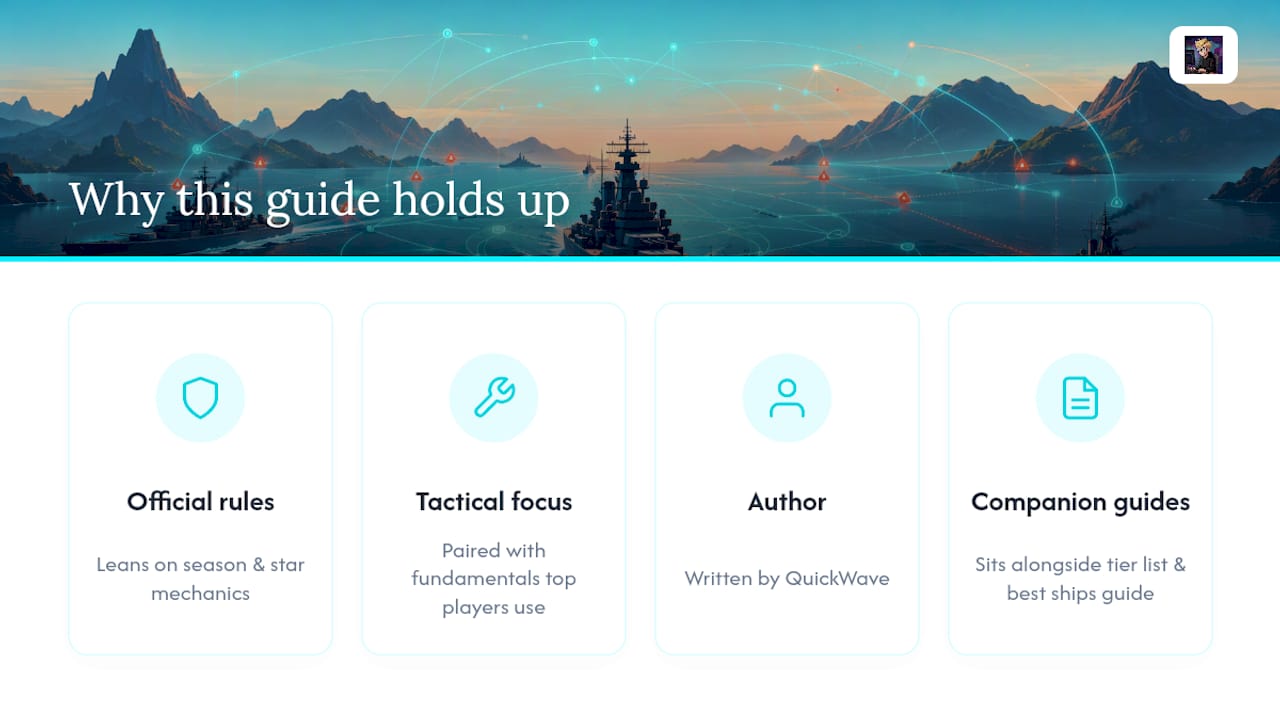
This site covers World of Warships strategy alongside titles like RAID: Shadow Legends, built around curated, practical guides rather than generic tips lists. This guide leans on official rule sources for season and star mechanics, paired with tactical fundamentals that top players consistently point to. Written by QuickWave, it's designed to sit alongside the tier list and best ships guide for readers who want a fuller picture before their next sprint.
What Most Ranked Advice Gets Backwards
Most Ranked content treats the mode like random battles with higher stakes, telling players to farm kills and chase damage numbers. That advice is backwards. The star-saving mechanic rewards base XP and survivability over frags, which means the player racking up spotting damage and cap time from a safe angle often outranks the player who died with a triple kill.
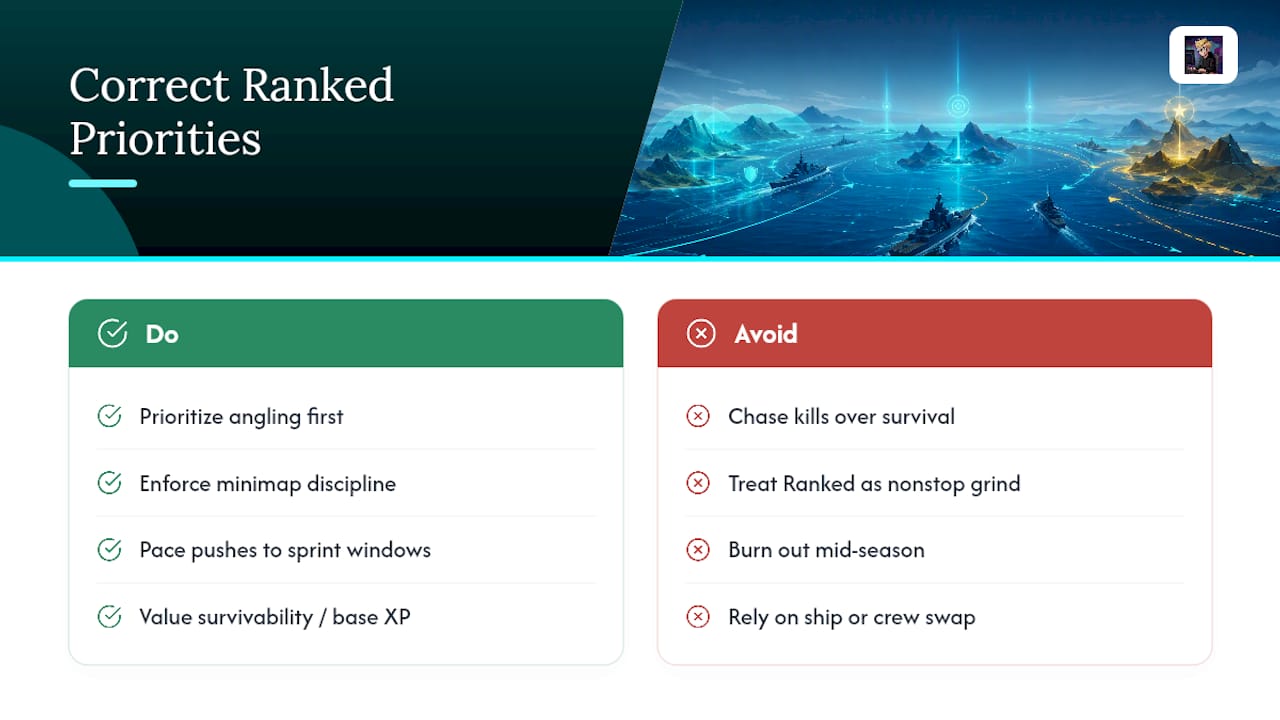
The conventional wisdom also underplays sprint timing. Players treat Ranked as one continuous grind and burn out mid-season chasing a rank they could have hit more easily by pacing their pushes to the start of a sprint's reward window. Season and sprint structure isn't a footnote. It's a scheduling tool.
What should you prioritize first? Angling and minimap discipline, in that order. Neither requires a new ship or a better crew build, and both cut your death rate faster than any tier list swap will. Everything else, ship selection, star management, sprint pacing, works better once you stop dying to preventable citadels.
— QuickWave
Where to Go After This Ranked Guide
Once the fundamentals click, the fastest way to keep climbing is matching your ship choice to what's actually working in the current meta. The Jay Plays Games tier list tracks which ships are overperforming right now, and the best ships guide breaks down builds by role so you're not guessing which captain skills matter for your class.
If you're still shaky on core mechanics like angling, ammo choice, or detection ranges, the beginner guide is worth a pass before you grind another sprint. This is an editorial resource built for players who want honest, practical breakdowns instead of recycled tip lists. Browse the full games hub for guides on other free-to-play titles worth your time between sprints, and bookmark the ranked-specific pages so they're ready the next time a new season drops.
Sources
- Ship:Ranked Battles - World of Warships Wiki
- Updates to Ranked Battles - World of Warships (news)
- What Are Ranked Battles and How to Play Them? | World of Warships (support)
- Ranked Battles seasons - WoWS Numbers - NA - World of Warships stats
FAQ
Is Ranked Better Than Random Battles for Improving?
Ranked forces sharper individual decision-making since divisions aren't allowed and every match matters for your rank, which makes it a faster way to sharpen positioning and survival habits than casual random battles.
What Is the Most Overpowered Ship in World of Warships?
There's no single ship that dominates every tier and season since balance patches shift the meta regularly. Check the Jay Plays Games tier list for current standouts by class and tier.
What Counts as a Good Win Rate in World of Warships?
Win rate benchmarks vary by tier and ship class, but consistently surviving matches and contributing base XP matters more for Ranked progress than chasing a specific win rate number.
Which Ship Class Is Best in World of Warships?
No single class is universally best. Cruisers often carry Ranked objective play well, destroyers dominate capping and spotting, and battleships anchor flanks, so the right choice depends on your role and the current season's meta.
How Do Stars Work if I Lose a Ranked Match?
Star-saving rules let the top XP earner on a losing team keep their star in some leagues and seasons, which is why prioritizing spotting, capping, and assists pays off even in a loss, per the official Ranked Battles rules.