
Start in Co-op Battles, try all four ship classes across a few nations up to Tier VI, and learn angling and minimap habits before you touch Random Battles. That single sentence covers the most common WoWS beginner guide advice across the community, and it holds up. The Wargaming Wiki confirms that new accounts receive protected matchmaking and Co-op access specifically so you can learn mechanics without getting punished by veteran players. The official World of Warships education pages document controls, firing basics, and mode options for anyone just getting started.
Here is your immediate plan:
- Battles 1–3: Drop into Co-op with a Cruiser. Practice firing, turning, and staying alive.
- Battles 4–6: Switch to a Destroyer. Learn spotting and torpedo basics.
- Battles 7–8: Try a Battleship. Focus on angling and long-range gunnery.
- Battles 9–10: Enter Random Battles and test everything you have learned.
Follow the Starter Checklist section below for the full step-by-step breakdown.
Key Takeaways
Starting in Co-op, playing across all four ship classes up to Tier VI, and mastering angling and minimap habits before entering Random Battles gives new World of Warships players the fastest path to consistent improvement.
| Point | Details |
|---|---|
| Start in Co-op | Use Co-op Battles for your first 10 matches to learn mechanics without PvP pressure. |
| Play across classes to Tier VI | Try Destroyers, Cruisers, Battleships, and Carriers across multiple nations before rushing one line. |
| Angle toward incoming fire | Showing broadside is the single most common cause of sudden, massive damage for new players. |
| Check the minimap every 15 seconds | Regular minimap scans prevent flanking, torpedo ambushes, and poor positioning. |
| Jayplaysgames WoWS guides | The Jayplaysgames World of Warships hub covers best ships, tier lists, and economy guides for every stage. |
Table of Contents
- How does the Port and tech tree work in World of Warships?
- Which ship class and nation should you start with?
- What game modes are available, and how does matchmaking protect new players?
- Core combat mechanics every beginner needs to know
- How should you spend XP, credits, and upgrades early on?
- 12 quick beginner tips you can apply right now
- Your first 10 games: a step-by-step starter checklist
- Common beginner mistakes and how to fix them
- Why the basics matter more than your ship tier
- More World of Warships guides from Jayplaysgames
- Sources
- FAQ
How does the Port and tech tree work in World of Warships?
The Port is your home base. Every ship you own sits in the carousel at the bottom of the screen, and you can filter by class, nation, or tier using the tabs above it. Click any ship to bring up its panel on the right, where you can access modules, consumables, commander assignment, and the battle button.
The Tech Tree (found in the top navigation) shows every ship in the game organized by nation and class. Ships are unlocked with XP earned in battle, then purchased with credits. Before you spend either, preview the ship's stats and read its description. Some lines reward aggressive play; others punish it. Knowing that before you commit saves you from buying a ship that does not match how you want to play.
- Modules: Upgrade your ship's hull, guns, torpedoes, and engine in the Upgrades tab. Hull upgrades usually come first since they improve HP and gun range.
- Commanders: Assign a commander to every ship. Commander skills amplify your ship's strengths, so a cruiser commander and a battleship commander should be built differently.
- Battle types: The Battle! button has a dropdown. Use it to switch between Co-op Battles, Random Battles, and Operations. You will not see all modes at account start.
Pro Tip: Before buying any Tier V or VI ship, open the Tech Tree, hover over it, and check the module costs. Some ships need two or three module upgrades before they perform well, and those upgrades cost credits on top of the ship price.
Which ship class and nation should you start with?
World of Warships organizes its fleet into four primary classes, each with a distinct role on the battlefield. Picking the wrong one for your playstyle is one of the fastest ways to get frustrated early.
Destroyers (DD)
Fast, stealthy, and armed with torpedoes. Destroyers spot enemies, lay smoke screens, and threaten larger ships with torpedo salvos. The catch: they have almost no armor. One salvo from a battleship at close range ends your game. For beginners, DDs teach concealment and map awareness faster than any other class, but they punish mistakes harshly.
Cruisers (CL/CA)
The most forgiving class for new players. Cruisers have decent guns, reasonable speed, and enough armor to survive a few hits if you angle correctly. They can support destroyers, contest caps, and deal consistent damage. Most beginner guides, including the DealTreats World of Warships beginner guide, recommend starting here because the feedback loop is clear: shoot, angle, survive, repeat.
Battleships (BB)
Slow, heavily armored, and capable of devastating single salvos. Battleships are satisfying to play but punishing if you sail in a straight line. Angling is non-negotiable at this class. New players often love BBs for the big damage numbers but struggle with positioning and getting caught broadside.
Aircraft Carriers (CV)
Carriers play entirely differently from surface ships. You control squadrons of planes rather than a single hull. The controls documentation covers the basics: press 1, 2, or 3 to select a squadron, use W/A/S/D to move them, and trigger attack runs with the designated key. CVs have a steep learning curve and affect the whole team's game. Save them for after you understand surface combat.
Starter nation recommendations
- United States: Balanced ships at every tier. American cruisers and battleships are textbook examples of their class, which makes them ideal for learning fundamentals.
- Japan: Strong torpedoes and good concealment on destroyers. Japanese cruisers and BBs teach long-range play.
- Germany: Tough hulls and good secondary guns on battleships. German ships reward aggressive, close-range play.
Pro Tip: Playing across multiple nations and classes at low to mid tiers builds intuitive knowledge of citadel locations, torpedo arcs, and concealment ranges on ships you will face as enemies. That cross-training pays off at every tier above VI.
What game modes are available, and how does matchmaking protect new players?
New accounts start with access to Co-op Battles only. In Co-op, you fight alongside other players against AI-controlled ships. The bots are predictable, which makes Co-op the right place to learn firing mechanics, angling, and basic positioning without the pressure of a competitive match.
Random Battles unlock after a short progression threshold. This is the main PvP mode, where you face real players in a 12v12 format. Matchmaking places ships within two tiers of each other, so a Tier V ship will face Tier IV, V, and VI opponents at most.
The Wargaming Wiki confirms that new-player protections exist specifically to prevent beginners from being dropped into high-tier matches against experienced players. Use that window.
Suggested progression timeline:
- Battles 1–10: Co-op only. Learn the basics of each class.
- Battles 11–20: Mix Co-op and Random Battles at Tier IV–V.
- Battles 21+: Commit to Random Battles. Use Co-op only to test new ships.
Operations (PvE scenarios with specific objectives) become available later and are worth trying once you are comfortable in Random Battles. They offer good credit and XP rewards with a more structured challenge than open PvP.
Core combat mechanics every beginner needs to know
Getting the fundamentals right changes your survival rate faster than any ship upgrade. Here is what actually matters.
Aiming and leading targets
Ships move, so you have to fire where the target will be, not where it is now. At medium range (roughly 10–12 km), aim one to two ship-lengths ahead of a moving target. At long range (15+ km), the lead increases significantly. The game's aim reticle adjusts as you zoom in; use it as a reference, then adjust based on where your shells land.
AP vs. HE ammo
Armor-Piercing (AP) punches through armor and deals heavy damage, including citadel hits, when fired at the right angle against broadside targets. High-Explosive (HE) deals reliable damage against angled ships, destroyers, and superstructures, and starts fires. The general rule: use AP against broadside cruisers and battleships, switch to HE when a target is angled or when you are in a destroyer. A citadel hit penetrates the ship's armored core and deals massive damage, often one-third to one-half of a ship's HP in a single salvo.
Angling
Never show your full broadside to an enemy. Angle your ship at roughly 30–45 degrees toward incoming fire. This forces shells to travel through more armor, reducing penetration and damage. The official controls documentation specifically highlights constant course and speed changes as a core survival habit, and it is correct. A ship sailing in a straight line is an easy target for both guns and torpedoes.
Torpedoes and evasion
Torpedoes have an arming distance, meaning they need to travel a short distance before they become active. At close range, a torpedo launched point-blank may not arm in time. When you see torpedo warning indicators on your screen, turn your ship to face the spread at an angle rather than turning broadside. Reducing the number of tubes that can hit you is the goal.
Spotting and concealment
Ships are only visible when they are within your detection range or spotted by an ally. Destroyers have the lowest detection range and can disappear into concealment by stopping fire and moving away. Radar and Hydroacoustic Search (Hydro) consumables can detect hidden ships, so do not assume you are safe just because no one is shooting at you.
Pro Tip: When a battleship salvo is incoming, turn toward the shells at an angle rather than away. Turning away shows your broadside. Turning in reduces the surface area the shells can hit.
How should you spend XP, credits, and upgrades early on?
Progression in World of Warships runs on two currencies: XP (used to research ships and modules in the Tech Tree) and credits (used to buy them). Spending both wisely early on keeps your ships competitive without leaving you broke between matches.
What to prioritize:
- Hull upgrades first. More HP and better gun mounts make an immediate difference.
- Main battery upgrades second. Better guns mean more damage per salvo.
- Torpedoes and engines third. These matter, but hull and guns affect survival more directly.
- Commander skills: Focus on survivability and main battery skills first. Concealment Expert is worth picking up on destroyers and cruisers once it becomes available.
Consumables are temporary items used in battle. The most important ones for beginners:
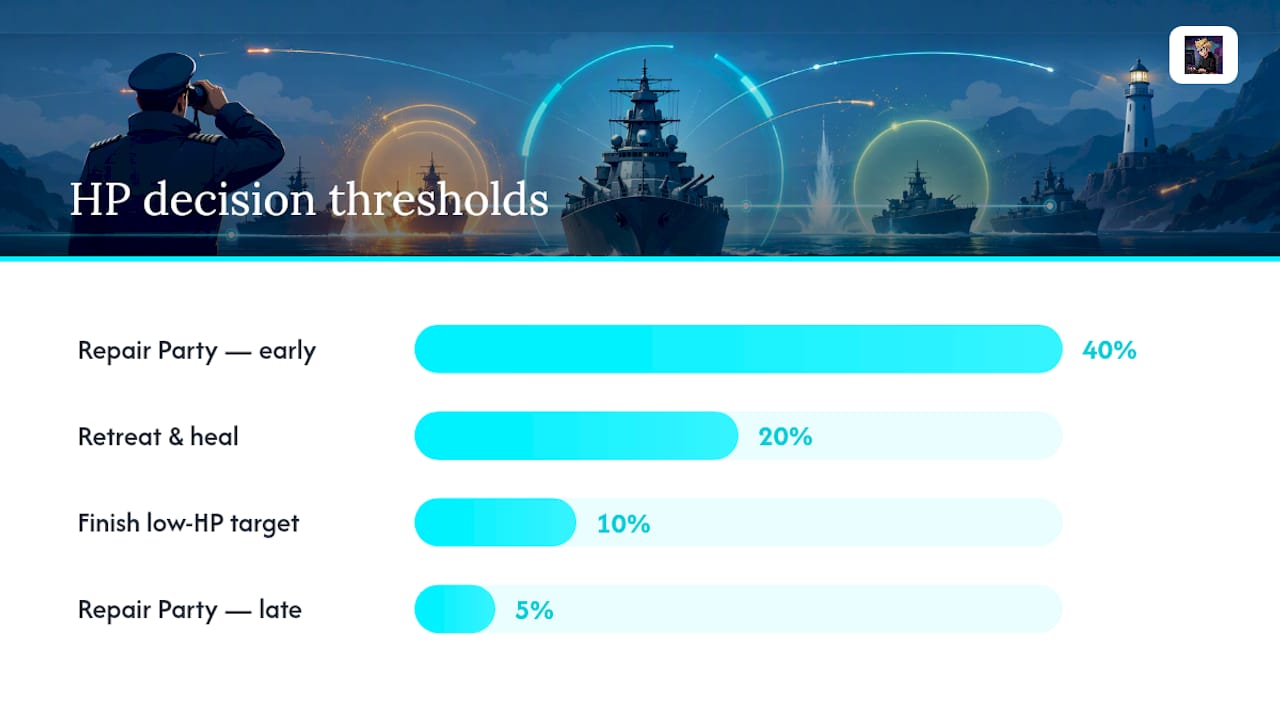
- Repair Party: Heals a portion of your HP. Use it when you drop below 50% health, not at 90%.
- Smoke Generator: Creates a smoke screen to hide in. Destroyers and some cruisers carry this.
- Hydroacoustic Search (Hydro): Detects torpedoes and ships through obstacles. Use it when pushing around islands or entering a cap.
- Damage Control Party: Automatically active; extinguishes fires and floods. Do not manually activate it for a single fire; wait until you have two fires or a flood.
For a deeper breakdown of credits and XP decisions, the WoWS economy guide on Jayplaysgames covers the numbers in detail.
Pro Tip: Spend XP and credits as you earn them. Hoarding them while playing an under-upgraded ship costs you more in lost battles than the savings are worth.
12 quick beginner tips you can apply right now
These habits, drawn from high-impact beginner advice and community-sourced tips on Reddit's r/WorldOfWarships, deliver the fastest improvement per match.
- Angle constantly. Never sail flat broadside to an enemy. Thirty degrees toward incoming fire is your default.
- Check the minimap every 15 seconds. Know where your allies and enemies are before you commit to a position.
- Switch ammo for the situation. Broadside cruiser? AP. Angled battleship? HE. Destroyer? HE.
- Finish low-HP targets first. A ship at 10% HP that survives will keep dealing damage. Eliminating it removes a full gun platform from the enemy team.
- Use islands as cover. Position behind an island so only your guns are exposed. This is called island-hugging and it is a legitimate tactic for cruisers.
- Stay with your team. Isolated ships die first. Grouped ships force the enemy to split fire.
- Retreat before you die. A ship that retreats at 20% HP and heals is more valuable than one that charges in and sinks.
- Use concealment actively. Stop firing, turn away, and disappear when you are being focused. Re-engage from a new angle.
- Use consumables early, not late. A Repair Party used at 40% HP keeps you alive longer than one used at 5%.
- Smoke is for the team, not just you. Parking in your own smoke while allies are exposed wastes the consumable.
- Never sail in a straight line for more than 20 seconds. Change course and speed regularly.
- Read the post-battle report. Check where your damage went, how many citadels you scored, and how many times you were set on fire. One lesson per match compounds fast.
Pro Tip: Prioritizing low-HP targets over high-HP ones wins more matches than raw damage farming. Reducing the enemy's gun count faster than they reduce yours is the core of team-based naval combat.
Your first 10 games: a step-by-step starter checklist
Use this as a structured learning loop. Each block of battles has one primary focus.
- Battle 1: Enter Co-op with a Tier II or III Cruiser. Focus only on firing mechanics and basic movement. Do not worry about dying.
- Battle 2: Same ship. Practice angling toward enemy fire. Try to survive longer than Battle 1.
- Battle 3: Still in Co-op with the Cruiser. Use your Repair Party consumable at least once. Note when it helped.
- Battle 4: Switch to a Destroyer in Co-op. Practice staying concealed and launching torpedoes at close-to-medium range.
- Battle 5: DD again. Focus on spotting: stay near the edge of your detection range and relay enemy positions to your team.
- Battle 6: DD one more time. Try using smoke to disengage when you are being focused.
- Battle 7: Switch to a Battleship in Co-op. Practice angling and long-range gunnery. Aim for citadel hits on broadside cruisers.
- Battle 8: BB again. Focus on positioning: stay 12–15 km from the main fight and support your team with accurate salvos.
- Battle 9: Enter Random Battles with whichever class felt most natural. Apply everything from Co-op. Expect to make mistakes.
- Battle 10: Random Battles again. After the match, open the post-battle report and identify one specific mistake to fix next session.
- After each session, note one thing you did well and one thing to improve.
- Check the Wargaming Wiki game basics page if a mechanic confused you mid-match.
- Use Co-op to test any new ship for 3–5 battles before taking it into Random.
Common beginner mistakes and how to fix them
These errors show up in nearly every new player's first 20–30 matches. Recognizing them early cuts the learning curve significantly.
- Rushing tiers. Buying Tier VII or VIII ships before mastering Tier V mechanics puts you in matches where every opponent knows your ship's weaknesses better than you do. The Wargaming Wiki explicitly warns against this. Stay at Tier V–VI until your win rate stabilizes.
- Showing broadside. The most common cause of sudden, massive damage. Fix: angle at 30–45 degrees toward the threat at all times.
- Not checking the minimap. Players who ignore the minimap get flanked, torpedoed from unseen destroyers, and caught out of position. Fix: glance at it every 15 seconds as a deliberate habit.
- Hoarding consumables. Saving your Repair Party for a "perfect moment" and dying before using it is a waste. Fix: use consumables when the situation calls for them, not when you are already sinking.
- Poor upgrade priority. Buying torpedo upgrades before hull upgrades on a cruiser leaves you fragile. Fix: hull first, main battery second, everything else after.
A practical drill set:
- Drill 1: Play three Co-op battles with the sole goal of never showing broadside. Count how many times you fail.
- Drill 2: Set a timer for 15 seconds and check the minimap every time it goes off. Do this for two full matches.
- Drill 3: Use every consumable at least once per match for five straight battles. Get comfortable with the timing.
Why the basics matter more than your ship tier
Most players assume that a better ship fixes their problems. It rarely does. Angling, minimap awareness, and concealment management are skills that scale with every tier. A player who angles correctly in a Tier V cruiser will outperform a player in a Tier VIII cruiser who sails broadside. The fundamentals do not become optional at higher tiers; they become more punishing when ignored.
Following the first-10-games checklist reduces early frustration because it gives you a measurable goal for each session rather than a vague sense of "getting better." Progress feels real when you can point to a specific habit you built. That sense of progress is what keeps players in the game long enough to reach the tiers where the real depth opens up.
More World of Warships guides from Jayplaysgames
Jayplaysgames covers World of Warships from the ground up, with guides built specifically for players who want honest, practical advice without the noise.
If this WoWS beginner guide gave you a solid starting point, the next step is knowing which ships are actually worth your XP and credits. The WoWS best ships page breaks down top picks by class and tier, so you are not guessing when you hit Tier VI. For a full overview of every WoWS guide on the site, the World of Warships hub is the place to start. And if you want to explore other free-to-play titles with the same level of depth, the Jayplaysgames games library covers everything from RPGs to strategy MMOs.
Head to the Jayplaysgames WoWS hub now and pick your next guide.
Sources
- Ship:Game Basics - World of Warships Wiki
- Training | World of Warships
- Controls and Firing | World of Warships
- World of Warships tips and tricks
- World of Warships Beginner’s Guide: Everything New Players Need to Know - DealTreats
FAQ
Which nation is best for beginners in World of Warships?
The United States tech tree is the most beginner-friendly. American ships at Tier IV–VI are balanced across all classes, which makes them ideal for learning fundamentals before branching into more specialized lines.
Which ship class is easiest to play in World of Warships?
Cruisers are the most forgiving class for new players. They offer a mix of firepower, speed, and survivability that gives clear feedback on what works and what does not, without the extreme fragility of Destroyers or the slow pace of Battleships.
Can World of Warships be played solo?
Yes. Co-op Battles let you play against AI opponents without relying on a team, and Random Battles place you in a team automatically. No premade group is required at any point.
How do you start over in World of Warships?
Wargaming does not offer an in-game account reset. If you want a fresh start, you need to create a new account through Wargaming.net. Your existing account and its ships remain on the original login.