
Cruisers win by controlling space, choosing the right consumables, and switching ammo at the right moment. That's the whole game in one sentence, but pulling it off means mastering five things: positioning that keeps you alive, ammo choice that maximizes damage per salvo, consumable timing that turns radar and smoke into map control, a captain build suited to your role, and target priority that keeps you useful instead of dead. This world of warships cruiser guide breaks each piece down so you can apply it in your next match, not just understand it in theory.
Before you queue up again, run this three-step check:
- Pick a role (sniper, brawler, or radar support) and load the ammo that fits it, not the ammo you default to.
- Save your Repair Party or Damage Control Party mentally before the fight starts, not after you're on fire.
- Ask "what can hit me right now" before every course change. That question alone will save more games than any module upgrade.
Key Takeaways
Winning cruiser games depends on matching ammo type to target angle, timing consumables to the moment they matter, and holding positions that protect your broadside while contesting map control.
| Point | Details |
|---|---|
| Ammo follows angle | Switch to AP on broadside targets and HE on angled or bow-in ships to avoid wasted salvos. |
| Consumables are proactive | Use radar, hydro, and Engine Boost before you're spotted or threatened, not after. |
| Positioning beats stat-checking | Island cover and angle discipline keep you alive longer than any module upgrade. |
| Nation choice shapes playstyle | Radar, smoke, and repair access differ by nation and should match your preferred role. |
| Practice ammo switching directly | Co-op drills targeting ammo reaction time build the habit faster than reading theory alone. |
Table of Contents
- Cruiser Types and the Job Each One Does
- How Do AP, HE, and SAP Shells Actually Work?
- Which Consumables and Modules Should You Fit?
- Which Nation's Cruisers Fit Your Playstyle?
- Captain Builds for Kiting, Brawling, and Radar Support
- How to Position a Cruiser for Map Control
- Ammo Switching and Target Priority in Combat
- Pro Tips That Separate Good Cruiser Players From Great Ones
- Sources
- FAQ
Cruiser Types and the Job Each One Does
Every cruiser line pushes you toward one of four jobs, and knowing which one you're playing changes everything about how you position. Light cruisers snipe from 12 to 16 kilometers, using rate of fire and HE spam to chip down anything that gets careless. Heavy cruisers trade some concealment and rate of fire for armor and AP punch, letting them brawl at 6 to 10 kilometers when the situation demands it. Torpedo cruisers, mostly found in the Japanese and Pan-Asian lines, play the ambush game from behind islands or smoke. AA and support cruisers exist to keep destroyers honest with radar and hydro, and to keep carriers from ruining your team's day.
Cruisers are genuinely the jack-of-all-trades class, and that flexibility is exactly why the line rewards players who understand which job they're doing in any given match, not just how to click on enemy ships.
- Sniping role: stay at max range, use concealment to control when you're visible, and disengage the moment a destroyer gets close.
- Brawling role: angle constantly, watch your Repair Party cooldown, and only commit when you have support nearby.
- DD-denial role: hold mid-range with radar or hydro ready, and let your detection range do the work before you ever fire a shot.
- AA/escort role: stick near battleships and carriers, and treat Defensive AA Fire as a timing tool, not a panic button.
If you're new to the class entirely, the beginner guide covers the fundamentals of ship classes before you specialize into cruisers.
How Do AP, HE, and SAP Shells Actually Work?
AP shells penetrate armor and can deal citadel damage when the target angle and plating thickness line up, while HE shells trade raw damage for guaranteed penetration and fire chance. SAP sits between the two, built for lightly armored ships like cruisers and destroyers that shrug off HE but don't have the plating to stop AP either. Picking the wrong one for the situation is the single biggest damage leak at every skill level.
Ballistics matter as much as ammo type. Shell flight time, dispersion, and lead all shift with range, so a shot that lands clean at 8 kilometers might sail over the same target at 14. Longer range means more drop, more lead, and more forgiveness for target maneuvering, which is exactly why nations with flatter trajectories (Germany, the U.S.) feel more consistent up close while high-arc shooters (Russia, Japan) reward patience at distance.
A few testable rules:
- Enemy cruiser or destroyer showing broadside inside 10 kilometers: switch to AP. The citadel potential dwarfs anything HE does.
- Enemy battleship angled bow-in with no broadside: HE. Your AP will bounce or overpenetrate; HE guarantees damage and starts fires.
- Target is a lightly armored cruiser at any angle where AP might ricochet: SAP splits the difference and punishes indecisive angling.
- Target is heavily armored and end-on: hold fire or wait, because feeding either ammo type into a well-angled battleship wastes the salvo.
Pro Tip: The "always use HE" habit is the most expensive mistake in cruiser play. Community veterans consistently point out that switching to AP the instant a target shows broadside turns a mediocre salvo into a citadel farm. Practice the switch until it's automatic, because hesitating for even two seconds after spotting a broadside often means the target has already started angling back.
Which Consumables and Modules Should You Fit?
Most cruisers get up to four consumable slots, and the first one is always locked to Damage Control Party. What fills the other three defines your entire playstyle far more than your captain skills do. Smoke Generator turns a light cruiser into a stationary gun platform. Surveillance Radar and Hydroacoustic Search turn any cruiser into a destroyer's worst nightmare. Engine Boost buys you the extra few knots to disengage or reposition before a battleship's alpha strike lands.
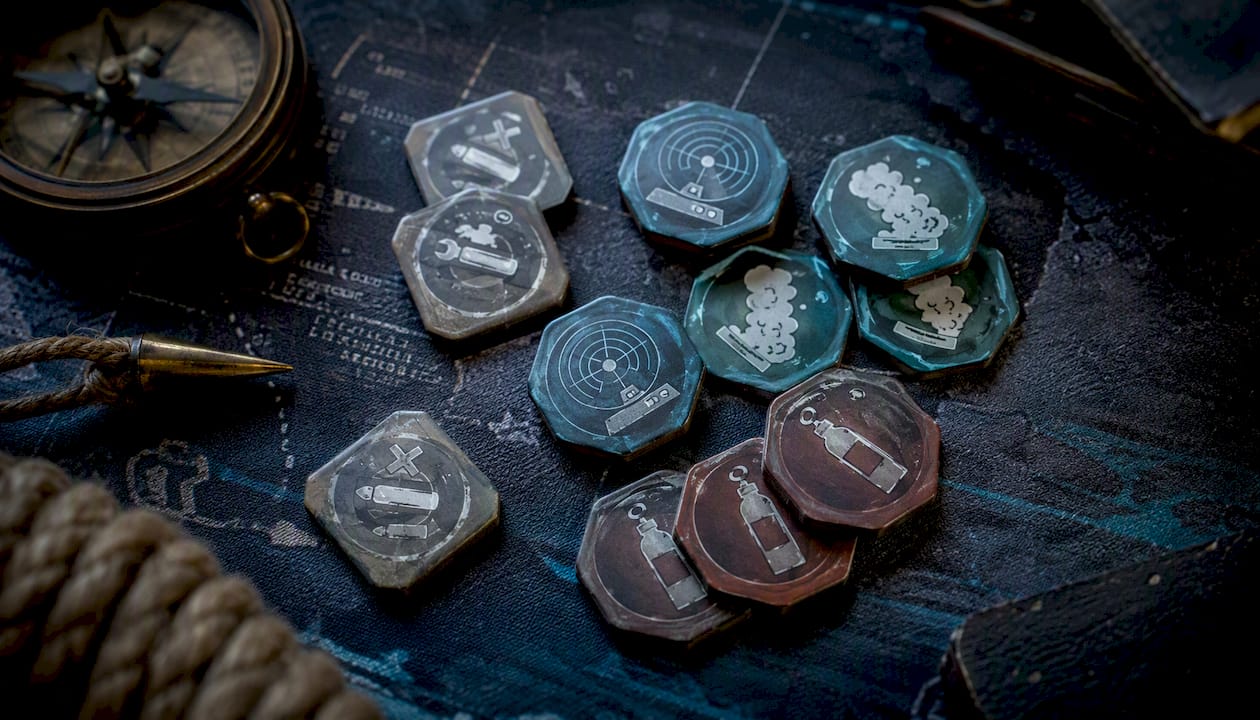
Module priorities follow your role. Sniping builds want the concealment module and gun fire control upgrades that extend range. Brawling builds want the survivability module and engine upgrades that help you angle out of trouble faster. Support builds want the consumable-cooldown-focused module so radar and hydro come back sooner, because uptime on those tools often matters more than raw stats.
Timing rules that actually hold up in practice:
- Pop radar the instant you suspect a destroyer is hiding in smoke near a cap, not after it's already torpedoed you.
- Use hydro proactively near islands where torpedoes are likely, rather than reactively after you're already spotted.
- Save Repair Party until you're below 50% health unless a burst of incoming damage threatens to kill you outright.
- Trigger Engine Boost before you're already spotted and under fire, since the speed bonus does nothing for the volley already in the air.
Higher tiers add complications. Some cruisers gain access to Spotting Aircraft or Catapult Fighter instead of a second offensive consumable, and cooldown reduction skills stack meaningfully with premium consumable variants, so check your specific ship's slot layout before assuming a build translates cleanly from tier 8 to tier 10.
Which Nation's Cruisers Fit Your Playstyle?
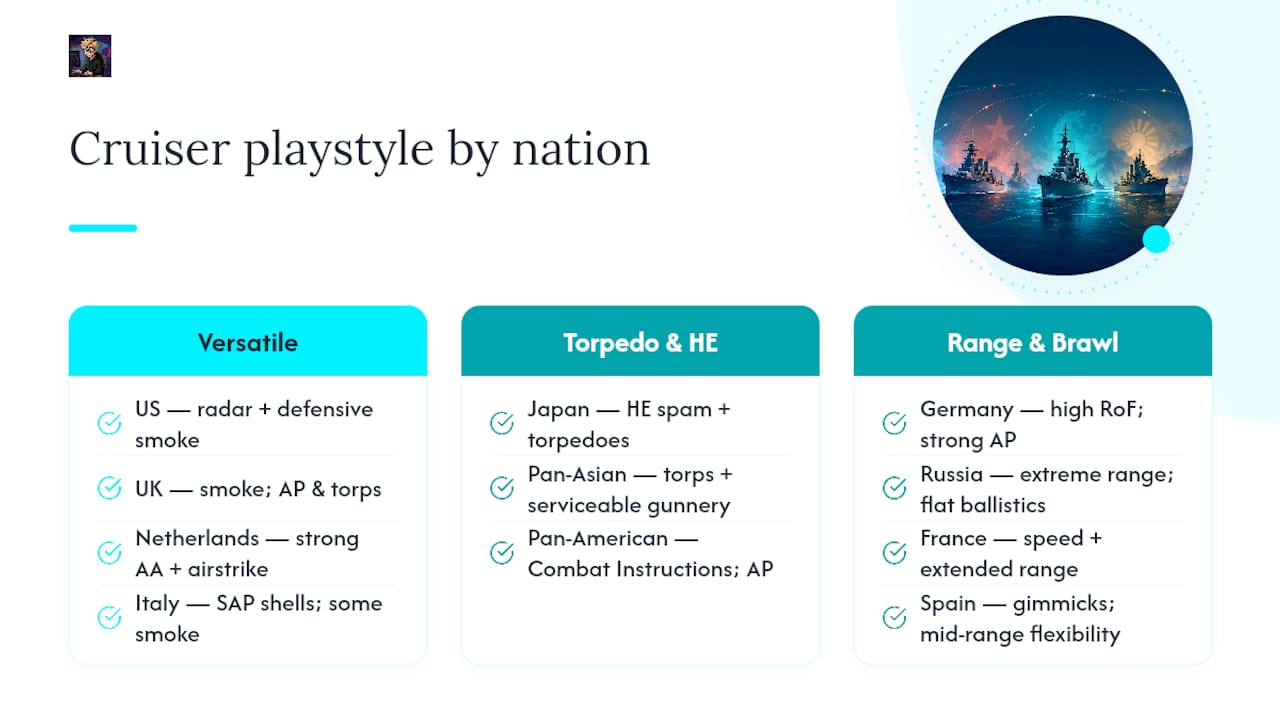
Nation identity in World of Warships cruisers comes down to consumable access and ammo type more than raw stats. Here's the breakdown, nation by nation, based on how each line actually plays out in a match.
United States cruisers balance AA power with solid all-around stats and access to both radar and a defensive smoke screen at higher tiers. Pick this line if you want a forgiving, versatile ship that supports the team without demanding perfect positioning.
Japan leans into HE spam and torpedo ambushes, especially on ships like the Zao, which combines strong torpedoes with respectable gunnery. Pick Japan if you enjoy flanking and punishing overextended enemies with torpedo walls.
Germany (Kriegsmarine) trades range for rate of fire and strong AP performance, rewarding aggressive, close-range play. Pick Germany if brawling and citadel-farming broadsides sounds more fun than sniping from max range.
France offers speed and extended range, letting you kite battleships that can't catch you while still contributing meaningful damage. Pick France if you want a hit-and-run playstyle built around repositioning constantly.
Russia (Soviet) cruisers fire at extreme range with high muzzle velocity, flat trajectories, and minimal armor to protect them if caught. Pick Russia if precise long-range sniping appeals to you more than surviving a brawl.
United Kingdom splits between AP-only light cruisers with smoke and heavier ships with torpedo options, giving you flexibility depending on the ship. Pick the UK if you like smoke-screen positional play with the occasional torpedo surprise.
Italy brings SAP shells to the cruiser line, a mechanic almost unique to this nation, alongside smoke screens on some hulls. Pick Italy if you want to punish lightly armored targets that laugh off HE.
Netherlands cruisers hit hard with strong AA and airstrike consumables that double as offense and defense. Pick the Netherlands if you want a ship that's genuinely useful against both carriers and surface targets at once.
Pan-Asian cruisers mix torpedoes with serviceable gunnery, playing similarly to Japan but with distinct hull characteristics. Pick this line if the Japanese playstyle appeals but you want a change of ship handling.
Pan-American cruisers run a unique Combat Instructions system that speeds up consumable cooldowns through sustained main-battery hits, paired with AP-focused ballistics and improved ricochet angles. Pick this line if you want a playstyle that rewards constant aggression over passive positioning.
Spain cruisers focus on unusual gimmick mechanics tied to specific hull upgrades, generally favoring mid-range engagements with a mix of AP and HE flexibility. Pick Spain if you want a line that plays a little differently from the rest and keeps you adapting mid-match.
For a broader sense of which lines are currently strong, the tier list is worth checking, though tier placement shifts with balance patches more often than most players expect.
Captain Builds for Kiting, Brawling, and Radar Support
Your commander skills should match the role you picked above, not a generic "best skills" list copied from a forum post. Three builds cover most situations.
Kiting and sniping builds prioritize skills that extend detection range advantage, improve dispersion at range, and boost survivability against the occasional lucky hit. Concealment-focused skills matter enormously here, since staying unseen while shooting is the entire strategy.
Brawling and armored builds lean into survivability skills, faster Repair Party healing, and damage reduction against fire and flooding. Superheal synergy with Repair Party upgrades turns a marginal brawl into a winnable one.
Support and radar builds focus on consumable cooldown reduction above almost everything else, since radar and hydro uptime is what makes a support cruiser valuable to the team. Detection-range skills that help you spot destroyers first also pair well here.
Module choices should reinforce whichever build you pick: gun fire control for snipers, survivability modules for brawlers, and consumable-focused upgrades for radar boats. Mixing builds rarely works, because cruiser captain points are limited enough that half-measures leave you weak everywhere instead of strong somewhere.
How to Position a Cruiser for Map Control
Positioning is where most cruiser games are actually decided, long before the final ammo count matters. Hold angles near islands so you can peek, fire, and duck back before return salvos land. Island-kiting works especially well against battleships, since you break their aim window every few seconds while still contributing damage.
Support carriers and battleships from an angle where your broadside stays hidden. Sitting directly behind an ally feels safe but exposes you the moment they turn, so stagger your position slightly instead. Contesting caps means using your detection range advantage: if you can see a destroyer before it sees you, you control the engagement, not the other way around.
For DD denial, hold position where your radar or hydro range overlaps the most likely destroyer approach, usually near caps or narrow channels between islands. Firing radar the moment you enter that zone, rather than waiting for a spot, often catches destroyers mid-approach.
- Island-peek pattern: expose broadside for one salvo, then reverse behind cover before the enemy's return fire lands.
- Retreat path: always know your route back to friendly AA and radar coverage before you push forward, not after you're already spotted.
- Cap contest: use concealment to enter a cap unseen, then commit only once you've confirmed what's defending it.
Community-tested fundamentals back this up directly: never show broadside to a battleship unless you're actively repositioning through the exposure, and treat islands as your primary defensive tool rather than your engine.
Ammo Switching and Target Priority in Combat
When a battleship shows broadside at 12 kilometers, that's an AP window. Switch immediately, aim for the waterline or superstructure depending on your caliber, and expect one or two citadel hits if your aim holds. If that same battleship angles back to bow-in before your salvo lands, switch to HE for the next volley rather than wasting AP on an armor belt built to stop it.
Target priority shifts by class. Destroyers demand immediate attention if spotted, since they threaten torpedoes and can shred your health if left unchecked. Cruisers are your bread-and-butter targets for AP citadels when they expose broadside. Battleships are secondary targets unless they're already low or badly angled. Carriers, when reachable, are high-value kills because removing enemy air power changes the whole match.
- Spot the target and identify its angle before committing to an ammo type.
- Load the ammo that matches that angle, not the ammo that matched your last target.
- Fire, then immediately reassess whether the target has changed angle for your next salvo.
- Reposition if return fire is likely, rather than standing still to admire the damage numbers.
Torpedo timing matters if you're playing a line that carries them. Launch when a target is committed to a course, ideally from a concealment advantage, and never fire torpedoes as a parting gift while retreating unless the angle genuinely works. Baiting overextensions means presenting just enough bow to look vulnerable without actually exposing your citadel, drawing enemies into range of your teammates.
Pro Tip: *Heavy cruiser brawls live and die on angling discipline.
Anti-Aircraft Duty and Working With Carriers
Cruisers with strong AA suites should prioritize sticking near carriers and other high-value targets, since your AA bubble often decides whether an enemy carrier's strike gets through. Defensive AA Fire is a timing tool, not a reflex. Save it for the moment a strike is committed and inbound, not the second a scout plane appears.
Catapult Fighters work best used proactively to deny enemy spotting near your position, especially in areas where a recon plane would otherwise reveal your location. Communicate with friendly carriers about which flank needs air cover, since a carrier player who knows your AA is strong on one side will route strikes elsewhere, effectively letting your presence shape enemy behavior without firing a shot. That coordination extends to general team play too, and resources like Megasports Arena's guide to team-based naval combat cover similar coordination principles that translate well across naval combat games.
Pro Tips That Separate Good Cruiser Players From Great Ones
The HE-only habit costs more damage over a full match than almost any other single mistake, and the fix is repetition, not theory. Set aside time in co-op battles to practice switching ammo on command, timing the switch to the moment a bot ship exposes broadside rather than reacting late.
Pan-American players face a unique wrinkle: Combat Instructions decay quickly once you stop landing hits, so maintaining the buff means balancing aggression against overcommitment. Pulling back to reposition is sometimes correct even if it costs you progress, since dying with a full buff bar helps nobody.
Pro Tip: Run three drills in co-op or training mode: ammo-switch reaction time against bots that angle randomly, radar timing against a simulated destroyer rush, and Repair Party discipline where you force yourself to heal at a fixed health threshold instead of waiting for a "safe" moment that never quite arrives.
- Drill 1: ten rounds of pure ammo switching, tracking how often you guess wrong before firing.
- Drill 2: hydro and radar timing against AI destroyers approaching from different angles.
- Drill 3: forced Repair Party discipline at 50% health, no exceptions, to build the habit under pressure.
How I Tested These Rules
These rules come from reviewing replays across ranked, random, and co-op matches, comparing what separated winning cruiser games from losing ones, and cross-checking those patterns against official Wargaming guidance and community consensus. The goal was consistency: rules that hold up whether you're grinding tier 6 or pushing tier 10, not situational tricks that only work once. For more ship-specific breakdowns, the best ships guide on Jayplaysgames covers individual standouts worth grinding toward.
If cruisers aren't scratching the itch you're after, Jayplaysgames covers plenty of other free-to-play titles worth your time, including the full games library and dedicated hubs like the Mech Arena guide for players who want a different flavor of tactical combat.
Sources
FAQ
Which Cruiser Is the Best in World of Warships?
There's no single best cruiser since it depends on role. Ships like the Zao (torpedo ambush) and top-tier U.S. or Pan-American cruisers (radar and support) each dominate different situations rather than one universal pick.
Which Nation Has the Best Cruisers in World of Warships?
No nation is objectively best across the board. The nation lines each specialize differently: Germany and Italy favor brawling and SAP damage, Russia and France favor range and speed, and the U.S. and Netherlands favor AA and support duty.
Which Cruiser Line Is Best in World of Warships in 2026?
Meta shifts frequently, so treat any single "best line" claim cautiously. Current tier list trends favor lines with strong radar or hydro access and reliable AP ballistics, but checking an updated tier list closer to your play session is more reliable than any fixed ranking.
Is a Destroyer or a Cruiser Better?
Neither is strictly better since they fill different jobs. Destroyers excel at stealth, torpedoes, and cap-contesting, while cruisers offer more durability, better AA, and stronger sustained gun damage, making the "better" ship entirely dependent on the role your team needs filled.