
Spend your first session in Training and Co-op mode, not Random Battles. Try one ship from each class up to around Tier VI so you feel out destroyers, cruisers, battleships, and carriers before picking a favorite. Focus on staying alive over chasing kills, and learn when your consumables actually help. That's the whole plan.
TL;DR:
- Playing one ship from each class up to around Tier VI helps identify which style suits you best and prevents early specialization pitfalls.
- The first hours should focus on setting up controls, watching beginner tutorials, and practicing in bot matches to build fundamental skills risk-free.
- Consistently checking the minimap and angling ships correctly greatly increases survival chances and reduces early deaths, which improves overall win rates.
- Focusing on survival, using islands for cover, and timing consumables like Damage Control Party are key tactics to stay afloat longer in battles.
- Reviewing post-battle reports after each match reveals common mistakes, guiding effective skill and strategy development during your first 50 fights.
Table of Contents
- What Is the Fastest Way to Start Playing World of Warships?
- Which Ship Class Should You Learn First?
- How Does Progression Work in Port and the Tech Tree?
- What Battle Modes Should Beginners Play?
- Which Tactics Actually Raise Your Win Rate?
- How Do You Survive Longer in a Match?
- What's a Realistic Practice Plan for Your First 50 Battles?
- Why Playing Across Lines Beats Rushing One Ship
- Official and Authoritative Resources to Verify
- Sources
- FAQ
What Is the Fastest Way to Start Playing World of Warships?
Your first hour or two should follow a specific sequence, not random exploring. Get your settings right, then get repetitions in against bots before anyone else's torpedoes are involved.
Here's the order that works:
- Fix your UI first. Bump up minimap size in the settings menu and enable damage indicators. You'll be checking that minimap constantly, so make it easy to read.
- Check your controls. W/A/S/D handles movement, Shift toggles sniper aiming mode, and R fires your Damage Control Party. Know these cold before you're under fire.
- Watch the official beginner training material, then queue into three Co-op matches against bots. This is where mistakes cost nothing.
- Run one ship per class (destroyer, cruiser, battleship, carrier, and a submarine if you're feeling brave) up to around Tier VI to get a feel for how differently each one plays.
- Practice your consumables in low-stakes moments. Pop Repair Party and Damage Control Party when nothing's wrong, just to learn the animation and cooldown. Test sniper-mode aiming against a stationary bot ship.
Which Ship Class Should You Learn First?
Every match runs on four ship classes, sometimes five if submarines are in rotation. Each one asks something different of you.
- Destroyers are fast, stealthy, and torpedo-heavy, built for scouting and ambushes at close range. They reward good instincts but punish mistakes hard. High skill ceiling, steep learning curve.
- Cruisers sit in the middle: decent guns, decent armor, and enough versatility to fill whatever role a match needs. Most beginners find cruisers the easiest class to feel competent in fast.
- Battleships are slow, heavily armored, and hit hard at range. Forgiving of positioning mistakes early, less forgiving once you're spotted broadside.
- Aircraft carriers fight through squadrons instead of guns, managing air wings across the whole map. The mechanics are unlike anything else in the game and take real time to learn.
- Submarines operate on depth control and acoustic homing torpedoes, a genuinely different rhythm from surface ships.
Wargaming's own guidance backs up what most veteran players will tell you directly: try multiple nations and classes up to around Tier VI before locking into one line. Specializing too early means you never find out what you're actually good at.
How Does Progression Work in Port and the Tech Tree?
Your Port is command central. It's where you buy ships, repair damage, manage your commander, and browse the tech tree. Every ship you unlock sits in a carousel you can flip through before each battle.
Progression runs on four resources, and understanding what each one does saves you from wasting them:
- Ship XP unlocks the next hull, module, or ship in a line. It's earned per ship and stays tied to that line.
- Free XP converts slower but works on any ship in any nation, useful for skipping a bottleneck.
- Credits buy ships and pay for repairs, ammunition, and commander retraining.
- Doubloons are the premium currency, spent on premium ships, camouflage, and commander retraining.
New accounts get temporary matchmaking protections that shield you from the highest-tier chaos. Use that window to experiment broadly instead of rushing toward Tier VIII. Early on, spend commander skill points on survivability and core handling rather than niche upgrades. Our economy guide breaks down credit management in more depth.
What Battle Modes Should Beginners Play?
Not every mode teaches the same lesson, and playing them in the wrong order slows you down.
- Co-op Battles pit you against AI with mirrored teams and up to nine players per side. This is your practice ground for ship handling, ammo behavior, and consumable timing with zero real risk.
- Training Rooms let you build custom bot matches to test a weird build or a new ship class without pressure.
- Random Battles are the main PvP mode, with the biggest rewards and the sharpest learning curve. Move here once you can survive consistently and read a minimap without thinking about it.
- Ranked and Clan Battles should wait. Give yourself at least 100 solid Random Battles before you step into modes where teammates expect you to already know the fundamentals.
Which Tactics Actually Raise Your Win Rate?
A handful of habits separate players who improve fast from players who plateau at the same rank for months. None of them require a better ship.
Check the minimap frequently during gameplay, full stop. Analyses of high-win-rate players consistently show that the first three to five minutes of a match set the tempo for everything after. Players who push too aggressively in that window usually die early and watch the rest of the match from spectator mode.
Beyond map awareness, a few specific habits matter most:
- Never show your broadside voluntarily. Angling your bow or stern toward the enemy shrinks your citadel and turns full-damage hits into bounces or overpenetrations.
- Use sniper mode (Shift) to aim, and lead your shots based on the target's range and speed. Co-op battles are a safe place to practice this without punishment.
- Match your ammunition to the target. AP against heavily armored ships, HE against lightly armored ones or when you can't get a good angle. Finish a low-health enemy before chasing a fresh damage number on a healthy one.
Pro Tip: Use islands as physical cover whenever you can. Sailing behind one forces enemies into bad firing angles and buys you time to reposition, which matters more than any single gun upgrade you could buy.
How Do You Survive Longer in a Match?
Survival isn't a defensive afterthought. It's the single biggest lever you have over your own performance, because a ship still afloat at minute fifteen keeps dealing damage and influencing the map.
- Save Damage Control Party for actual emergencies. It clears fires and floods instantly, but you get limited charges, so don't burn one on a single small fire you could ride out.
- Repair Party heals a percentage of damage taken, so timing it after a big hit (not immediately at the first scratch) gets you more value per use.
- If a submarine pings you, wait until the torpedoes are actually visible before canceling with Damage Control. Popping it too early lets the sub re-ping and re-activate the homing effect, wasting your consumable for nothing.
- Dodge torpedoes by turning your bow toward the spread and adjusting speed, rather than trying to outrun them in a straight line. Co-op is the right place to drill this until it's automatic.
What's a Realistic Practice Plan for Your First 50 Battles?
Structure beats random grinding. Here's a milestone breakdown that actually builds skill instead of just accumulating games played:
- Battles 1 to 5: Lock in your settings, controls, and run through Co-op until the UI feels natural.
- Battles 6 to 20: Play one ship per class up to around Tier VI, tracking which playstyle clicks for you.
- Battles 21 to 50: Pick a line to specialize in and start refining commander skills around that ship's strengths.
After every match, glance at the post-battle report. Look specifically at how you died: citadel hit, flooding, torpedo, or ammo starvation from missed shots. That single habit reveals repeat mistakes faster than reading any guide. Skip expensive module upgrades early. Commander skills that boost survivability give you more return per credit spent than a marginal gun upgrade on a ship you haven't mastered yet.
Why Playing Across Lines Beats Rushing One Ship
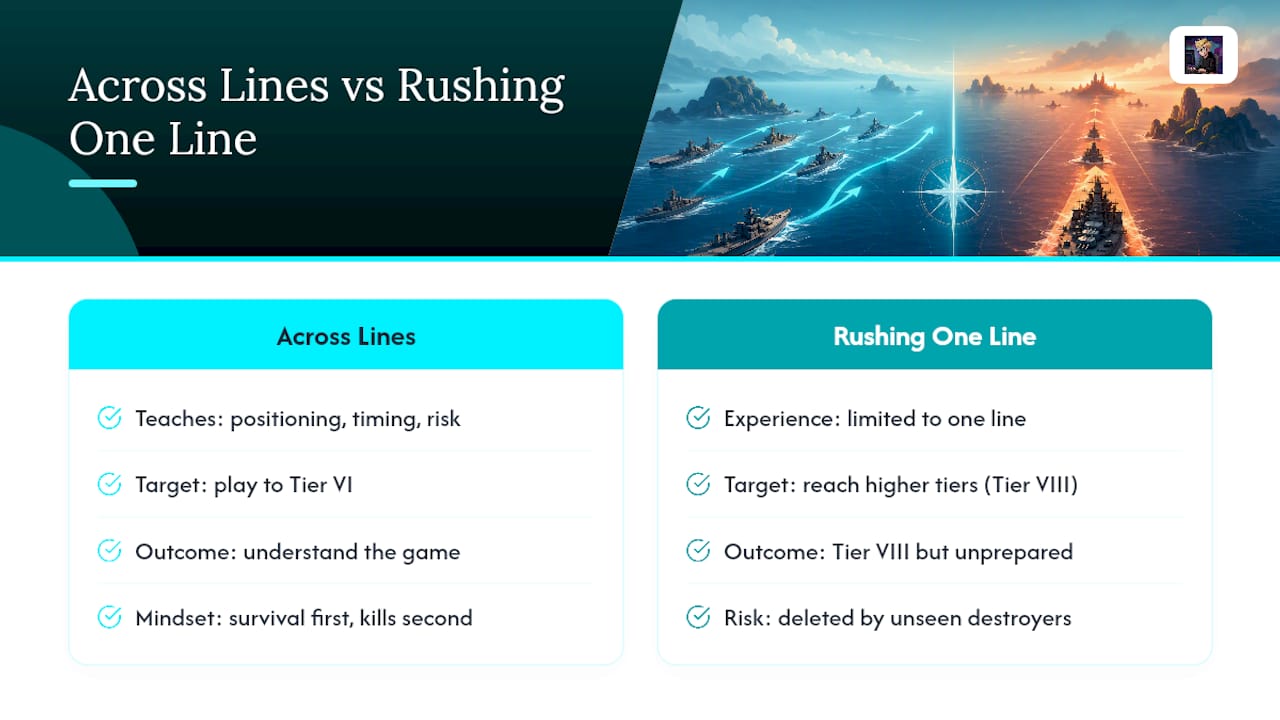
The play-across-lines-to-Tier-VI approach isn't a suggestion to slow you down for its own sake. It's the fastest route to actually understanding the game, because destroyers, cruisers, battleships, and carriers each teach a different lesson about positioning, timing, and risk. Skip that step and you end up in a Tier VIII battleship with no idea why you keep getting deleted by a destroyer you never saw.
Survival first, kills second, is the mindset that separates players who climb steadily from players stuck relearning the same mistake every match. If you want a deeper breakdown of which ships reward that mindset best, our best ships page and tier list go further than a single guide can. For a broader look at what else is worth your time, browse our full game guides.
— QuickWave
Official and Authoritative Resources to Verify
Cross-check anything here against Wargaming's own documentation before you commit real credits or doubloons to a build. Start with the Basics education page, the Game Basics wiki entry, and the Ship:Game Modes wiki page for mechanics you'll want to reference again later.
FAQ
What Are the Best Ships for Beginners in World of Warships?
There's no single best beginner ship. Cruisers tend to be the most forgiving class to start with because they balance decent guns and armor without punishing small mistakes the way destroyers or carriers do.
How Do You Play World of Warships as a Beginner?
Start in Co-op and Training Rooms to learn controls and consumables risk free, then try each ship class up to around Tier VI before specializing. Move to Random Battles once you can survive consistently and read the minimap without hesitation.
What Are Some Good Tips for Playing World of Warships?
Check the minimap frequently during gameplay, avoid showing your broadside, and match your ammunition type to the target's armor. Prioritizing survival over early aggression is one of the clearest habits shared by high-win-rate players.
How Should Total Beginners Approach Learning the Game?
Treat your first 20 to 50 battles as structured practice: fix your settings, sample every ship class, then specialize while reviewing post-battle reports to catch repeat mistakes like citadel hits or missed torpedo dodges.