

Endgame in RAID: Shadow Legends comes down to two things: a small roster of multi-role champions tuned correctly, and disciplined use of restricted content windows like Clan Boss and Hydra keys. Get those right and progression stabilizes, rewards get bigger, and burnout drops. Get them wrong and you'll grind endlessly without moving the needle on account power.
TL;DR:
- Focus on limiting-attempt content like Clan Boss, Hydra, and Doom Tower first, since resources invested here cannot be recovered and offer high rewards.
- Prioritize building a small core of multi-role champions for endgame, giving them relics and artifacts over spreading resources thin across many champions.
- Use restricted gear sets from Clan Boss, Hydra, and Doom Tower for Chaos Ore farming, and only farm from dungeons for sets that cannot be obtained through limited content.
- Maintain a disciplined routine, spending energy in boosted events and tracking progression milestones to avoid burnout and optimize resource use.
- Rotate teams and strategies based on specific boss mechanics and modes, rather than deploying a universal team, to maximize efficiency and success in high-level content.
Table of Contents
- What Raid Shadow Legends Endgame Actually Requires Daily
- How Do You Prioritize Champions for Endgame Teams?
- What's the Best Gear and Farming Strategy for Endgame?
- Progression Milestones and Resource Management That Actually Matter
- Advanced Tactics for Clan Boss, Hydra, Chimera, and Arena
- Jay Plays Games' Practical Endgame Checklist
- Beyond Arena: PvP Systems That Reward Endgame Accounts
- Dungeon Farming and Maximizing Rare Drops
- Getting the Most Out of Tournament Rewards
- Doom Tower Tactics Most Guides Skip
- Why Sustainable Play Beats Maxing Everything
- Where Jay Plays Games Fits Into Your Endgame Push
- Sources
- FAQ
What Raid Shadow Legends Endgame Actually Requires Daily
Established accounts aren't grinding campaign stages anymore. The daily/weekly loop shifts to a handful of high-value activities, and the order you tackle them in matters as much as whether you do them at all.
Limited-attempt content comes first, every single time. Clan Boss, Hydra, and Doom Tower keys don't refresh on a timer you control, so wasting a key on a sloppy run is a permanent loss. Farmable content, by contrast, is always there tomorrow. A disciplined routine secures limited-attempt rewards before spending anything on repeatable farming, and that sequencing alone separates accounts that compound advantage from ones that stall.
Here's what a realistic daily/weekly rotation looks like for an established account:
- Clan Boss keys — run your highest-difficulty killable or unkillable team first, since this is your primary source of ancient shards and 6-star gear.
- Hydra encounters — clear or progress toward one-key clears; Hydra fragments feed one of the strongest artifact-building loops in the game.
- Doom Tower rotations — hit the weekly reset hard, especially Hard/Nightmare floors, since Doom Tower gates unique gear sets you can't farm elsewhere.
- Faction Wars — often neglected, but it's a cheap source of champion shards and a solid speed-tuning test bed.
- Clan shop — spend energy and clan currency on 6-star gear pieces before they rotate out.
- Arena attempts — spend your free and token-based attempts even on lighter days; skipping Arena entirely wastes free progression.
If you're short on time, the rule of thumb is simple: skip campaign farming and dungeon runs before you skip Clan Boss, Hydra, or Doom Tower. Restricted content has a ceiling on how much you can do; farmable content does not.
How Do You Prioritize Champions for Endgame Teams?
Not every champion deserves a 6-star ascend and a full artifact set. Endgame accounts that spread resources thin across dozens of champions almost always progress slower than accounts that commit to a tight core. The strongest late-game rosters concentrate investment in a small number of multi-role champions rather than trying to build every rare pull that lands in the summon pool.
Use this framework to sort your roster:
- High priority — champions that perform in three or more game modes (Clan Boss, Hydra, Arena, Doom Tower): these get first access to relics, ascension mats, and top-tier artifacts.
- Medium priority — champions with one dominant role (a Clan Boss specialist, say) but limited crossover. Worth building once your high-priority champions are stable.
- Low priority — niche or situational champions. Build only if you have surplus resources or a specific Doom Tower rotation gap.
Speed tuning is where a lot of endgame teams quietly fall apart. The goal isn't just "faster is better." It's about turn order relative to your enemy and your own team's buff and debuff timing. A common tuning pattern: your control champion needs to act before the boss's turn meter fills, so your control champion needs enough speed to guarantee the first hit, depending on masteries and gear bonuses. These numbers are illustrative brackets, not universal targets, since every comp and boss tier shifts the math slightly.
Rotation stability also depends on debuff uptime. If your DoT or weaken effects fall off between turns, damage output collapses even if your champions are individually strong. Lock your gear once a rotation is stable, and treat masteries as part of the tuning puzzle, not an afterthought you fill in last.
Pro Tip: Before you swap a single artifact on a tuned team, write down your current speed values for every champion. One relic upgrade can shift turn order enough to break a Clan Boss rotation that took weeks to stabilize.
Deciding whether a champion deserves a 6-star ascend comes down to one question: does this champion's role improve meaningfully at 6-star, or is the jump mostly cosmetic? Champions with scaling A1 damage or percentage-based debuffs usually justify the investment. Pure support champions with flat buffs often don't need it as urgently.
What's the Best Gear and Farming Strategy for Endgame?
Endgame gear decisions hinge on one distinction: restricted sets versus farmable sets. Restricted gear comes from limited-attempt sources like Clan Boss, Hydra, and Doom Tower, while farmable gear drops from repeatable dungeons you can run any time you have energy. That difference should dictate where your Chaos Ore goes.
- Restricted sets — Stoneskin, Bloodthirst variants, and Doom Tower exclusive sets. Prioritize these for Chaos Ore since you can't simply farm more copies on demand.
- Farmable sets — Speed, Lifesteal, and standard dungeon sets. Save Chaos Ore here only if you're chasing a specific substat combination you can't get through normal drops.
- Re-rolling artifacts — only re-roll when a piece is close to your target speed or a key substat and you have Chaos Ore to spare after covering restricted gear needs.
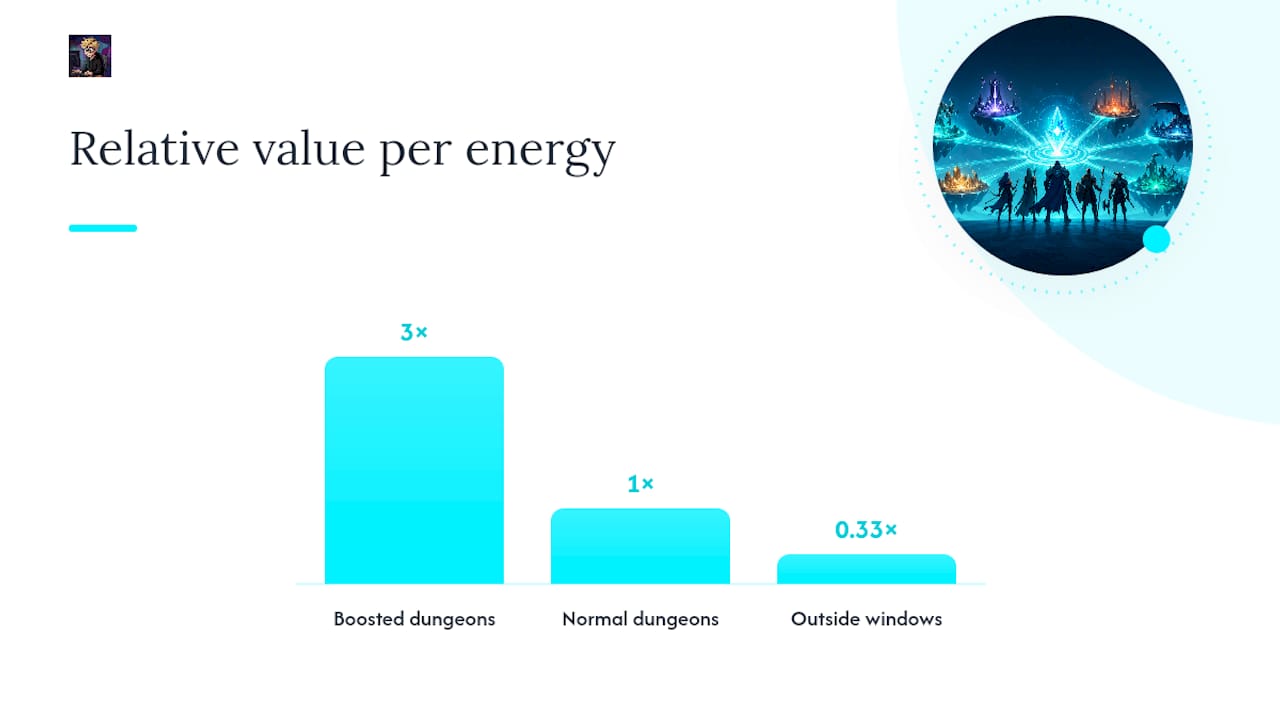
Boosted farming events change the math on everything. Farming efficiency depends on timing energy spending around 3x Speed and 3x Savage events, since energy spent outside those windows returns roughly a third of the value per point. Stack your dungeon and gear farming into boosted windows and use non-boosted days for Clan Boss, Hydra, and Arena instead, since those don't scale with the multiplier events anyway.
A quick gear-removal checklist for when Plarium runs a gear-removal event: pull substats you'd never re-farm intentionally (wasted flat stats on 6-star gear), keep anything close to your tuning targets, and always check the clan shop before the event closes since 6-star pieces there don't wait for you.
Progression Milestones and Resource Management That Actually Matter
Endgame progress is easiest to track with concrete thresholds instead of vague "get stronger" goals. Set targets like clearing campaign 12 Brutal on auto, reaching one-key Hydra clears on at least one head, and consistently hitting Ultra Nightmare Clan Boss reward tiers.
- Silver — spend on gear upgrades for your core roster before saving for masteries; silver droughts hit accounts that hoard it for "someday" reworks that never happen.
- Mythic shards — save for champions with confirmed multi-role value rather than spending on the next shiny release.
- Fusions — only chase a fusion event if the resulting champion fills a genuine roster gap; otherwise bank fragments for the next one.
- Energy — default to boosted events for dungeons, and never let energy cap out unused.
Burnout is a real progression killer. Practical endgame advice consistently flags avoiding overkill investment and keeping a short focus list as the difference between players who stick around and players who quit mid-season.
Advanced Tactics for Clan Boss, Hydra, Chimera, and Arena
Clan Boss splits into two archetypes at endgame: killable teams that race the boss down before enrage, and unkillable teams built around sustain and debuff uptime that grind Ultra Nightmare over the full timer. Clan Boss success at the highest difficulty depends as much on speed tuning and consistent debuff uptime as raw stats, which is why two accounts with similar champion power can have wildly different clear speeds.
- Killable Clan Boss — stack Crit Rate, Crit Damage, and Accuracy; sequence your hardest-hitting debuffs first so the boss dies before your sustain runs dry.
- Unkillable Clan Boss — prioritize Resistance, Tenacity, and Turn Meter Fill; a common tuning pattern puts your cleanser ahead of the boss's turn (boss around 170 speed post-buff, your cleanser tuned to 190+) so debuffs never stack past your team's sustain ceiling.
- Hydra — control champions go first; stunners and provoke-users need enough speed to lock down heads before they act. Gear swapped between Hydra rotations should preserve your speed bracket, not just raw stat totals.
- Chimera — single-target nukers matter more here than in Hydra, since Chimera's damage checks reward burst over sustained debuffs.
- Arena — decide early whether you're building a go-first team (speed-stacked, burst-focused) or a go-second team (built to counter the opponent's opener). Ban and prep decisions should follow your team's identity, not the meta champion of the week.
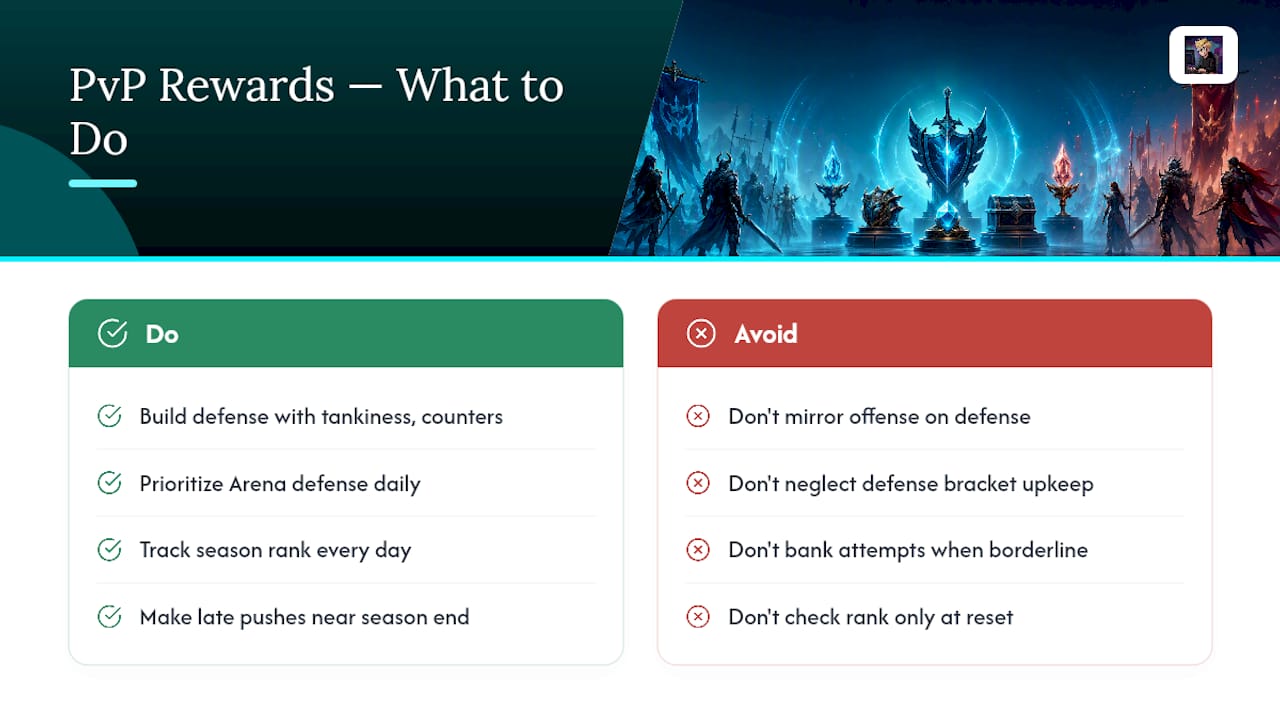
Pro Tip: In Live Arena, don't fully commit your best speed-tuned team to offense if your defense is soft. A strong defense team that holds rank protects more long-term reward value than an aggressive offense push that drops you a bracket after a few losses.
Jay Plays Games' Practical Endgame Checklist
Jayplaysgames covers Raid: Shadow Legends across dedicated guides for gear, Clan Boss, and Arena, each built to expand on the tactics above with current build examples.
A copy-paste daily checklist for your own routine:
- Clan Boss keys first, then Hydra attempts, then Doom Tower resets.
- Clan shop purchases before energy spending on farmable dungeons.
- Boosted events reserved for dungeon farming, not Clan Boss or Arena.
- Faction Wars run at least once daily for cheap shard income.
- Gear-removal and fusion calendars checked weekly, not reactively.
Beyond Arena: PvP Systems That Reward Endgame Accounts
Arena gets most of the attention, but two other PvP systems quietly reward disciplined endgame accounts. Arena Defense matters more than most players treat it. A defense team that holds a strong bracket generates passive Arena token income every day, and losing that bracket to a lazy defense setup costs more long-term value than most players realize. Build your defense around tankiness and counterattack mechanics rather than trying to mirror your offense team.
Ranked season rewards (Tag Team and Live Arena included) scale steeply near the top brackets, so climbing even one tier can be worth more than several days of Clan Boss farming. Ranked rewards optimization means tracking your season rank daily instead of checking once at reset, since late pushes near season end often net the biggest jumps for minimal extra effort. If you're borderline between two reward tiers close to reset, spend your remaining attempts there instead of banking them for the next season's climb.
Dungeon Farming and Maximizing Rare Drops
Dungeon farming at endgame isn't about clearing every dungeon evenly. It's about matching dungeon choice to your current gear gap. If you're missing a specific set for a tuning target, farm that dungeon specifically rather than rotating through all six for variety.
Rare drop rates improve meaningfully during boosted events, so save dungeon pushes for 3x Speed or 3x Savage windows whenever your calendar allows it. A sub-10-second campaign farmer setup, run during non-boosted downtime, keeps silver and basic shard income flowing without eating into your boosted-event energy budget. Treat your farmer team as a background system, not something you actively manage every session.
Getting the Most Out of Tournament Rewards
Tournaments reward consistency more than raw power in most brackets. Before a tournament starts, check the specific rules (some restrict champion rarity, gear rank, or team composition) and pre-build a compliant team rather than scrambling once it's live.
Spend your tournament energy early rather than late. Reward thresholds are usually structured so the first several clears net the best value per energy spent, with diminishing returns as you push toward the top of your bracket. If your account sits mid-pack in tournament power, focus on hitting the mid-tier reward thresholds reliably instead of burning resources chasing a top-10 finish that likely isn't realistic yet.
Doom Tower Tactics Most Guides Skip
Doom Tower's weekly reset rewards players who treat it as a rotation puzzle rather than a straight difficulty ladder. Secret Room floors often get skipped because they don't scale with your main progression, but they're a reliable source of tomes and gems that most standard guides underweight.
Rotate teams between Hard and Nightmare floors based on which specific boss mechanic they counter, rather than sending your single strongest team through every floor. A team built for the Spider boss's poison stacking mechanic will underperform against the Dragon's burn mechanic, even if both teams look similarly powerful on paper. Keep two or three specialized teams ready instead of one generalist squad, and you'll clear more floors per week with the same roster investment.
Why Sustainable Play Beats Maxing Everything
Chasing every leaderboard metric burns players out faster than any grind ever could. The accounts that last years, not months, tend to be the ones with a small, genuinely enjoyable core team rather than a maxed roster nobody has fun playing. Optimize for the modes you actually like running. Pick one system this week (Clan Boss tuning, Doom Tower rotations, whatever's been nagging at you) and fix just that.
— QuickWave
Where Jay Plays Games Fits Into Your Endgame Push
If the tactics above raised more questions than they answered, that's exactly what Jayplaysgames's Raid Hub exists to solve. It's built specifically for players past the beginner stage, with current build examples, updated tier context through the champion tier list, and deeper breakdowns of the gear and Clan Boss tactics covered here.
Whether you're chasing a specific Ultra Nightmare rotation or trying to nail down a Live Arena defense that actually holds rank, the guides expand on exactly the frameworks in this article with current examples pulled from the live meta. Check the Raid: Shadow Legends landing page for the full library of guides and start with whichever system is costing you the most time right now.
Sources
- Raidhq
- RAID: Shadow Legends Clan Boss Guide 2026 – How To Build Better Teams
- Champion Building in the Late Game of RAID: Shadow Legends - HellHades
- How to Farm in Raid Shadow Legends: The Definitive Efficiency Guide - InTeleria
FAQ
Who Is the Strongest Champion in Raid: Shadow Legends?
There's no single strongest champion since power depends heavily on mode and team composition, but multi-role champions that perform across Clan Boss, Hydra, and Arena consistently deliver more account value than single-purpose specialists.
Is Raid Shadow Legends Worth Playing in 2026?
For players who enjoy tactical team-building and long-term progression systems, yes. The game's endgame content (Clan Boss, Hydra, Doom Tower) rewards planning and patience over pure spending, which keeps it engaging for free-to-play accounts too.
How Hard Is It to Reach Level 50 in Raid: Shadow Legends?
Reaching higher account levels is mostly a matter of consistent campaign and dungeon farming over weeks rather than a difficulty wall, though the real challenge shifts to gear and champion optimization once you're there.
Is There a Cheat Code for Raid Shadow Legends?
No legitimate cheat codes exist for Raid: Shadow Legends. Progression comes from farming, event timing, and smart resource allocation, and using third-party cheat tools risks an account ban.