

Short answer: RAID: Shadow Legends is pay-to-progress with real pay-to-win pockets. Spending money speeds up almost every system in the game, and it gives a decisive edge in competitive PvP. Most PvE content, including Clan Boss and the campaign, stays reachable through patient free-to-play grinding. If you're casual, play free and enjoy it. If you want to compete at the top of the Arena ladder, budget for it.
TL;DR:
- Spending on energy refills can significantly speed up gear farming, reducing the months-long grind needed for top-tier artifact sets.
- Top-end PvE content remains accessible to free-to-play players through strategic planning and patience, but top PvP rankings favor paying accounts with better champions and gear.
- Paying players reach key milestones two to five times faster than free players, depending on spending efficiency and account management.
- Small, consistent spending on monthly value passes often yields better long-term results than sporadic large purchases or shard bundles.
- F2P players can progress well by focusing on farming efficiency, supporting champions, and coordinating game activity with clan bonuses.
Table of Contents
- Is RAID Pay to Win? The Systems That Turn Money Into Power
- Where Spending Actually Matters: PvE vs. PvP vs. Clan Endgame
- How Much Faster Do Paying Players Actually Progress?
- How to Progress in RAID Without Spending Heavily
- Should You Spend Money on RAID, and How Much?
- Jayplaysgames' Take on Progression Strategy
- Who Should Actually Play RAID?
- Get More Out of RAID With Jayplaysgames' Guides
- Sources
- FAQ
Is RAID Pay to Win? The Systems That Turn Money Into Power
RAID's shop is built around a handful of items, and each one converts cash directly into faster progress. Understanding what's for sale explains why the "raid pay to win" question keeps coming up in community threads.
- Shards (summon packs): buy chances at new champions instead of grinding them through events or Doom Tower.
- Energy refills: let you run more dungeons per day, which is the single biggest bottleneck in the game.
- Gear bundles: pre-built artifact sets that skip weeks of farming.
- Relics and blessings: stat boosts and set bonuses that push existing gear further.
- XP and skill upgrade packs: shortcut the slow grind of leveling champion skills to max rank.
The core mechanic underneath all of it is RNG. Summoning a specific legendary or mythical champion from shards is a low-probability roll, so buying more shards simply buys more rolls. It doesn't guarantee the champion you want, but it multiplies your attempts, and in a gacha system, attempts are the currency that matters.
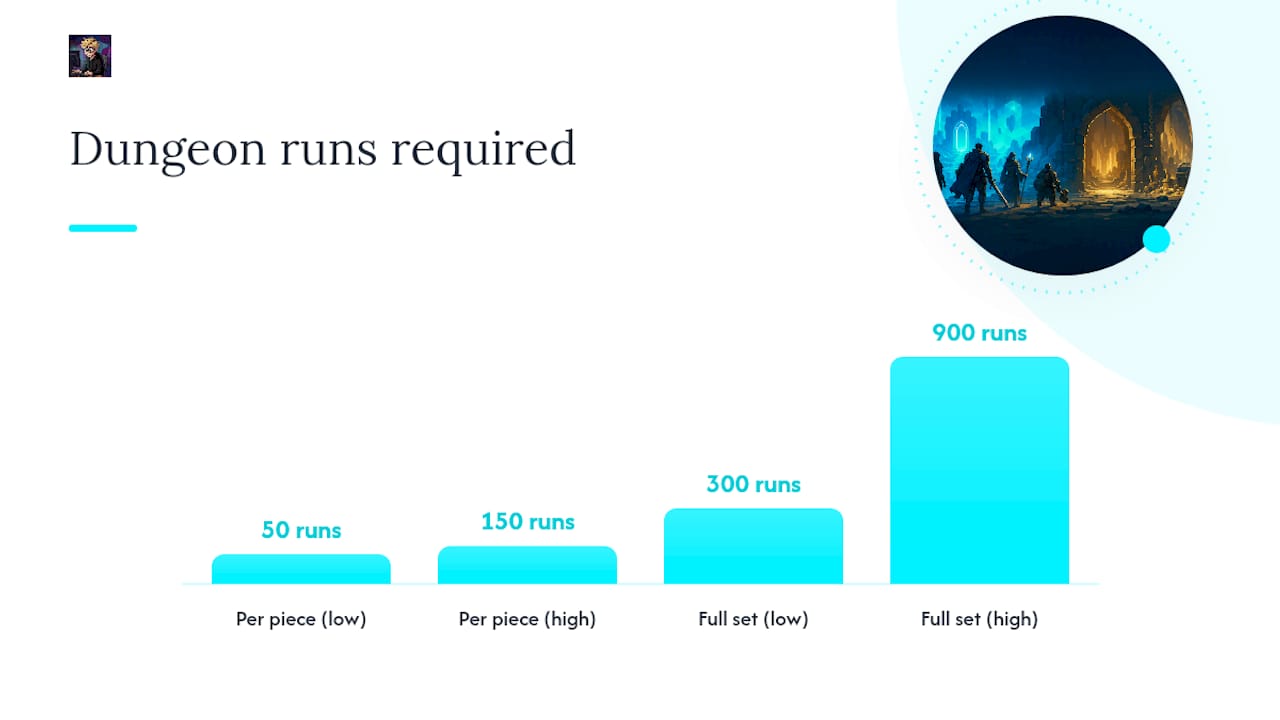
Energy works the same way in a different form. Every dungeon run costs energy, energy regenerates on a timer, and gear only drops from repeated runs. Analyst reporting from Mobile Game Report estimates it takes 50 to 150 runs to farm a single piece of a top-tier artifact set, and a full set needs six pieces. That math alone explains why energy refills are one of the most purchased items in the game: they don't buy gear, they buy the runs that eventually produce gear.
Statistic callout: At the low end of that estimate, a full six-piece set could take roughly 300 farming runs. At the high end, it could take closer to 900. Buying refills to compress that timeline is exactly what EarlyGame's analysis points to when it calls spending on energy and gear the clearest lever for accelerating progress.
Where Spending Actually Matters: PvE vs. PvP vs. Clan Endgame
Not every part of RAID rewards spending equally, and that's the piece most "is RAID pay to win" debates skip. Some modes are genuinely skill and patience driven. Others are close to decided by your credit card before the match even starts.
- Campaign and early dungeons: almost entirely beatable F2P with basic team building and patience.
- Clan Boss: rewards optimized gear and speed sets, and pushing into Ultra Nightmare difficulty often requires strong artifacts that take real farming time, but it's not gated by purchases alone.
- Doom Tower and late PvE events: favor accounts with deep champion rosters, which spending accelerates but doesn't strictly require.
- PvP Arena: the sharpest edge in the game. Wider champion pools, perfectly rolled gear, and access to meta-defining legendaries consistently favor spenders.
EarlyGame's breakdown draws this same line: PvP is disproportionately affected by spending, while PvE remains largely accessible through planning and time. A quick scan of community discussion on Reddit backs this up. Players consistently report enjoying the campaign, Clan Boss, and Faction Wars as F2P, while describing the top brackets of Classic Arena as dominated by accounts with maxed legendary and mythical rosters.
The aggregator site IsItP2W rates RAID heavily on the pay-to-win scale, largely because of how shard and gear purchases translate into Arena dominance. That's a fair criticism of the competitive ladder specifically. It's a much weaker criticism of the rest of the game, where a well-built F2P account can clear the vast majority of content given enough time.
How Much Faster Do Paying Players Actually Progress?
This is where "raid pay to win" stops being a feeling and becomes a number. 33rdSquare's analysis estimates paying players reach key milestones roughly 2 to 5 times faster than fully free-to-play accounts. That's a wide range on purpose. It depends on how much you spend, how efficiently you spend it, and how much account age and login luck already stack in your favor.
Here's how that gap tends to look across common spending tiers, based on community-derived farming math and analyst estimates:
Statistic callout: the 50 to 150 runs per gear piece figure from Mobile Game Report means an F2P player farming a single dungeon a couple of times a day is often looking at months, not weeks, for one complete artifact set. That gear wall is the real reason progression estimates spread so wide between tiers.
Treat every number in that table as a range, not a promise. RNG on shard pulls, gear stat rolls, and event drops means two accounts spending identically can land in very different places six months apart. Long-term F2P accounts that log in daily, farm efficiently, and stockpile shards for events can absolutely reach end-game content. It just takes patience most spenders skip past.
How to Progress in RAID Without Spending Heavily
You don't need to match a whale's budget to have a strong account. You need to be deliberate about where your gems, energy, and champion slots go.
- Spend gems on Mystery Shards and the Sacred Shard pool during rate-up events, not on impulse pulls during a normal week.
- Prioritize farming-friendly, free-to-obtain champions with support or control roles over chasing a single flashy legendary.
- Use your daily energy on the highest-value node available, usually whichever gear dungeon matches your current set-building goal, rather than spreading it thin.
- Time energy refills to double-drop events, so every purchased or free refill produces roughly twice the gear per run.
- Coordinate with your clan so Clan Boss attempts and raid participation line up with active resource bonuses instead of going to waste solo.
- Check for active promo codes before spending gems, since free codes can offset a chunk of what you'd otherwise buy.
Our beginner guide and farming guide walk through team-building and resource sequencing in more detail if you want the full playbook.
Pro Tip: Never buy shards the moment a new rate-up banner drops. Wait a day, check community pull reports for that specific event, and only spend if the reported odds actually look better than the standing baseline. Impatience is what turns a reasonable purchase into a bad one.
Should You Spend Money on RAID, and How Much?
Your ideal spend depends entirely on what you're chasing, not on what other players are doing.
- Casual players who just want to clear campaign, Faction Wars, and Clan Boss: stay $0. Nothing in that content requires purchases.
- Mid-core players who want a competitive Arena rank and solid Clan Boss contribution: a light, recurring budget, something like $10 to $20 a month, tends to outperform occasional large one-time purchases. 33rdSquare's analysis points to steady small spending as better long-term value than episodic shard binges.
- Competitive players chasing top-bracket PvP: budget for it honestly, or accept you're playing a different game than the whales at the top.
Safe starter purchases usually come from any monthly value pass tied to your login streak or Clan Boss chest, since those return more value per dollar than single shard packs.
Pro Tip: Avoid limited-time "mega bundles" advertised with a countdown timer. Their value is almost always weighted toward energy and gems you'd get anyway through normal play, not the gear or shards actually driving your account forward.
Jayplaysgames' Take on Progression Strategy
We built our RAID coverage around the same question most players are actually asking: can you get somewhere real without spending? Our tier list and best champions guide focus on champions that are both strong and realistically obtainable through normal farming and events, not just whatever's dominating the current meta banner. Our Clan Boss guide breaks down role assignments so a mid-tier account can still post a meaningful Ultra Nightmare contribution. One example straight out of that guide: a well-built Poisoner comp can carry F2P accounts through UNM long before they've farmed a single mythical.
Who Should Actually Play RAID?
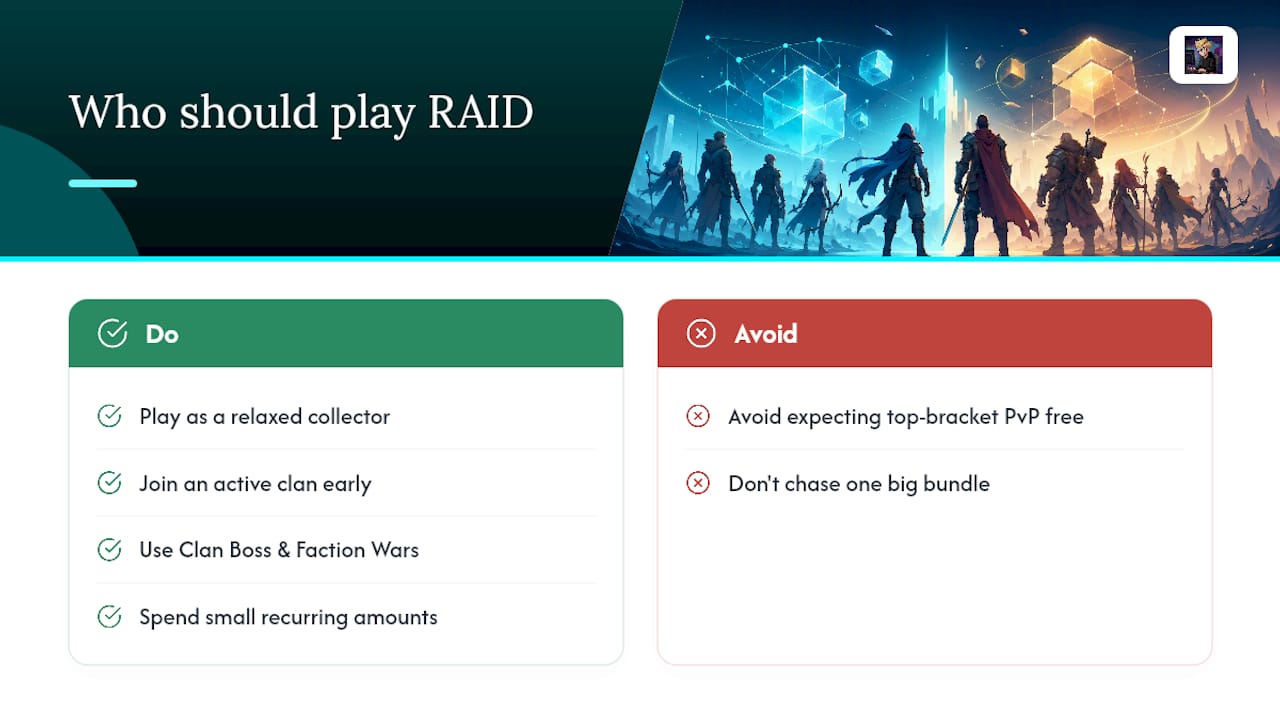
RAID rewards patience more than most players expect walking in. If you're looking for a relaxed collector-RPG you can chip away at daily, this is a strong fit, and you'll clear most content without spending a cent. If your goal is dominating top-bracket PvP, go in with realistic expectations about the budget that takes.
Join an active clan early and explore casual gaming communities like Flicksy - The Ultimate Movie, TV & Anime Trivia Rating Game for downtime fun. Clan Boss rewards and Faction Wars chests are some of the best free gear sources in the game, and a good clan multiplies what any solo F2P grind can produce. Whatever you decide to spend, spend it in small, recurring amounts rather than chasing a single big bundle. That's where the actual value sits.
— QuickWave
Get More Out of RAID With Jayplaysgames' Guides
Knowing that RAID is pay-to-progress rather than a hard paywall only helps if you know exactly where to put your time. That's the gap Jayplaysgames closes: our guides turn the general "farm efficiently" advice into specific routes, team comps, and resource priorities so your energy and gems go toward gear and champions that actually move your account forward.
Start with our Raid hub for the full library, then jump into the beginner guide if you're new, the farming guide if you're stuck at the gear wall, or the Arena guide if PvP is your target. For a deeper look at everything RAID related, our dedicated RAID: Shadow Legends page has the latest guide updates and champion breakdowns in one place. If you'd rather compare it against other collector RPGs before committing your time, browse our full games index.
Sources
- Raid Shadow Legends: At What Point Does Free-to-Play Stop Being Free? | Mobile Game Report
- Is RAID: Shadow Legends Actually Pay-To-Win? An Honest… | EarlyGame
- Is RAID Shadow Legends pay to win? A detailed analysis | 33rdSquare
FAQ
Is RAID: Shadow Legends Pay to Win?
RAID is pay-to-progress rather than strictly pay-to-win: spending speeds up gear, champions, and skill leveling, and it creates a clear edge in top-bracket PvP, but most PvE content stays reachable through F2P farming.
What Is the Most Pay-to-Win Mobile RPG?
There's no single agreed-upon "most" pay-to-win title since ratings vary by aggregator and mode, but RAID consistently ranks as heavily monetized in its competitive PvP specifically, per sites like IsItP2W, while its PvE stays more accessible.
Is RAID Worth Playing in 2026?
Yes, if your goal is casual to mid-core progression. The campaign, Clan Boss, and Faction Wars are all clearable F2P, and recent additions like Advanced Quests and the Bazaar have made free resource generation more workable, according to HellHades' community analysis.
Who Owns RAID: Shadow Legends?
RAID: Shadow Legends is developed and published by Plarium, a mobile game studio; ownership claims tying the game to a specific country's government are not accurate and aren't supported by any credible reporting.
How Much Should I Spend on RAID to Stay Competitive?
It depends on your goal: casual players can stay at $0, while players chasing competitive Arena ranks typically see better long-term value from a small recurring monthly budget than from occasional large bundle purchases.