

Yes, Path of Exile is worth playing if you enjoy tinkering with builds and don't mind a rough first ten hours. It's a free-to-play action RPG with more genuine depth than almost anything in its genre, built for players who want to theorycraft, grind, and optimize rather than click through a quick campaign. If you want something casual and forgiving, this isn't it.
TL;DR:
- Building a strong, effective character often requires following community-approved starter builds and planning your passive tree before investing points to avoid frustration.
- The game’s endgame is driven by seasonal leagues that introduce new mechanics and reset progress, keeping the game fresh and encouraging long-term play.
- Stash tabs become almost essential for organized inventory management once your collection of gear and crafting materials grows beyond a basic setup.
- The campaign lasts about half a day and functions mainly as a tutorial, while the enduring challenge and depth lie in the endgame systems and league progression.
- The free-to-play model guarantees no pay-to-win advantage, with monetization focused solely on cosmetics and convenience such as stash tabs.
Table of Contents
- Path of Exile Review: The Quick Verdict
- What Path of Exile Gameplay and Combat Actually Feel Like
- The Skill Tree and Gem System: Why Path of Exile's Build Customization Runs So Deep
- Campaign and Story: Is the 10-Act Journey Worth Playing Through?
- Leagues, Maps, and Why the Endgame Is Where Path of Exile Really Lives
- Monetization: Is Path of Exile Pay-to-Win?
- Starting Path of Exile: Common Pitfalls and Where to Get Help
- Jayplaysgames' Take on Who Should Play Path of Exile Now
- Our Perspective: Longevity Over Hype
- Sources
- FAQ
Path of Exile Review: The Quick Verdict
Path of Exile earns its reputation as one of the deepest action RPGs you can play for free. Three things stand out immediately: the sheer scope of build customization, a free-to-play model that doesn't lock power behind a paywall, and seasonal leagues that genuinely refresh the game every few months. Two things will test your patience: the learning curve is steep, and while nothing you buy makes you stronger, stash tabs start to feel less like a luxury and more like a requirement once your inventory fills up.
- Dive in if: you like optimizing systems, enjoy long-term grinding, and don't mind looking things up online
- Wait if: you want a game that explains itself, or you're only looking for a short, casual session
Reviewers have called it "high-maintenance" in the best and worst sense: IGN's assessment notes it rewards optimization far more than pick-up-and-play habits.
What Path of Exile Gameplay and Combat Actually Feel Like
Combat in Path of Exile is fast, chaotic, and satisfying once your build clicks into place. You're clicking to move and attack, chaining skills together, and watching screens fill with explosions, chain lightning, and stacking damage-over-time effects. Early on, a single skill gem carries you. By midgame, you're juggling five or six abilities modified by support gems, and the screen becomes a light show of overlapping effects.
The visual feedback is clear even in the chaos. Enemies flash on hit, status effects show distinct color coding, and damage numbers (when you turn them on) tell you instantly whether your build is scaling correctly. That clarity matters because Path of Exile's difficulty scales sharply, especially in group content, where monster density and damage output climb fast.
Playing solo versus co-op changes the rhythm noticeably. Solo play lets you control pacing and study enemy patterns. Co-op speeds everything up, throws more enemies at you, and rewards players who've already got their build's damage output sorted out. Neither mode feels like an afterthought, which isn't something you can say about every ARPG on the market.
The Skill Tree and Gem System: Why Path of Exile's Build Customization Runs So Deep
Path of Exile splits your character power between two systems that work together. Skill gems determine what your character actually does (fireballs, minions, melee strikes) while support gems slot in to change how those skills behave, adding extra projectiles, more damage, or entirely new mechanics. Layered on top is a single, massive passive skill tree shared by all seven classes, packed with keystones that can fundamentally rewrite how your character survives and deals damage.
That scale is the game's biggest draw and its biggest trap.
- The passive tree alone contains thousands of nodes, giving genuine build diversity between players running the same class
- Keystones and craftable jewels let you bend core mechanics (life, energy shield, elemental damage) in specialized directions
- The tradeoff: it's entirely possible to build a character that simply doesn't work, and you often won't know until you're deep into the campaign
Pro Tip: Don't freestyle your first build. Follow a community starter build or map out your passive tree on a planner before you start spending points. It saves hours of frustration and at least one full restart.
Campaign and Story: Is the 10-Act Journey Worth Playing Through?
The campaign spans ten acts and takes about half a day of play for an average first playthrough, according to IGN's review. The tone is bleak by design. You're a prisoner shipwrecked on Wraeclast, a continent overrun by corruption and monstrous cults, and the story unfolds through environmental storytelling, item lore, and sparse but effective voice acting rather than lengthy cutscenes.
Here's the honest part: most veteran players treat the campaign as an extended tutorial. It teaches you the mechanics you'll need, but the meaningful gameplay loop, the part that keeps players around for hundreds of hours, lives in the endgame. If you're only judging Path of Exile by its story, you're judging the wrong 30 hours.
Leagues, Maps, and Why the Endgame Is Where Path of Exile Really Lives
Leagues are Path of Exile's seasonal reset, and they're the single biggest reason players stick around for years instead of weeks. Each league introduces a new mechanic, resets character progress, and creates a fresh in-game economy, cycling every few months according to IGN's coverage. The official Path of Exile site documents how these seasonal rule sets and itemization systems, built around currency orbs and map modifiers, tie directly into the endgame loop.
Once you finish the campaign, you move into the Atlas, a web of maps with escalating difficulty and modifiers that stack rewards against risk. This is what pushes total playtime well past the campaign's 30 hours into the hundreds, sometimes thousands, for dedicated players.
- Fresh economy each league means your currency and gear from the last cycle don't carry over, keeping trade and crafting relevant
- Atlas progression unlocks stronger maps and bosses as you push further, extending the grind indefinitely
- New mechanics per league (special encounters, crafting systems, or standalone modes) keep veteran players from burning out on repetition
GameSpot's review singles out the endgame and item systems as the game's strongest features, even while flagging how overwhelming they can feel for newcomers.
Monetization: Is Path of Exile Pay-to-Win?
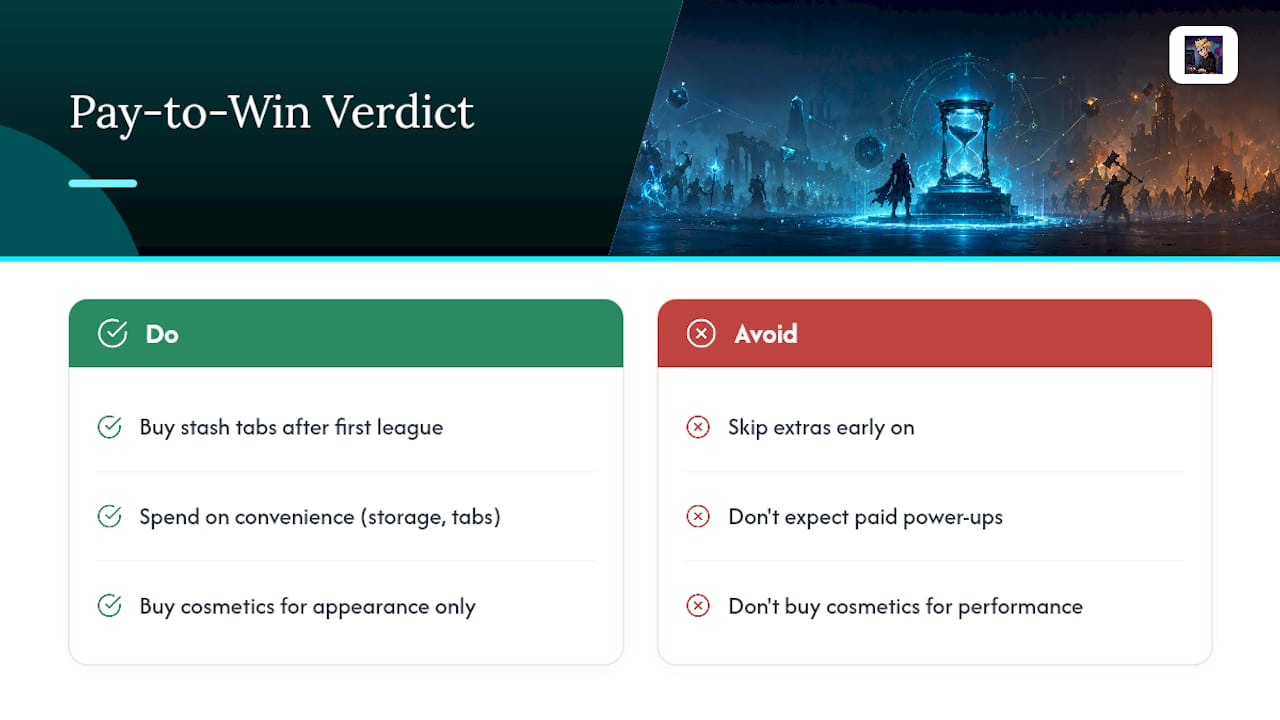
No. Cosmetics and supporter packs change how your character looks, not how it performs. That's the core promise Path of Exile has kept since launch, and it's a big part of why the free-to-play model has earned trust rather than suspicion.
Where money actually gets spent is convenience. Stash tabs, the storage system for your gear and currency, become close to essential once you're juggling crafting materials across multiple builds. PC Gamer's review notes that stash tabs are a near-mandatory purchase for serious players, not because the game forces it, but because manual inventory management gets tedious fast. Early on, skip the extras. Once you're committed past your first league, a few organizational tabs are worth the money.
Starting Path of Exile: Common Pitfalls and Where to Get Help
The in-game tutorial teaches you the buttons, not the strategy, which means new players routinely stumble into avoidable mistakes. Passive points get spent on nodes that don't support their build, and mechanics like resistances or flask management go unexplained until they cause a death.
- Avoid dumping passive points before you understand your build's damage scaling
- Pick a beginner-friendly ascendancy (Juggernaut and Ranger's Deadeye are common recommendations for new players) since they tend to forgive early mistakes better than glass-cannon options
- Lean on the PoE Wiki and community build discussions before committing to a passive tree
- Treat your first character as a learning run, not your final build
If you've navigated a steep learning curve before, like the systems in our World of Warships beginner guide, the pattern here will feel familiar: front-load your research, and the game gets dramatically easier.
Jayplaysgames' Take on Who Should Play Path of Exile Now
We cover free-to-play titles across genres, and few reward research the way Path of Exile does. If you're the type of player who enjoys planning a build on paper before touching the game, this is exactly your kind of grind. If you want something you can learn by feel in an afternoon, you'll bounce off it. That split is real, and it's not a knock on either type of player.
For the build crafters and long-term grinders reading this, start with a planned path rather than improvising. Our game guides library is a solid place to compare how different free-to-play RPGs handle progression before you commit your hours.
Our Perspective: Longevity Over Hype
The conventional advice on Path of Exile treats the campaign as the review. It isn't. Thirty hours of story tells you almost nothing about whether this game deserves your time, because the actual product is the endgame loop and the league cycle that follows it. Judge Path of Exile by whether you'd enjoy the hundredth hour, not the first.
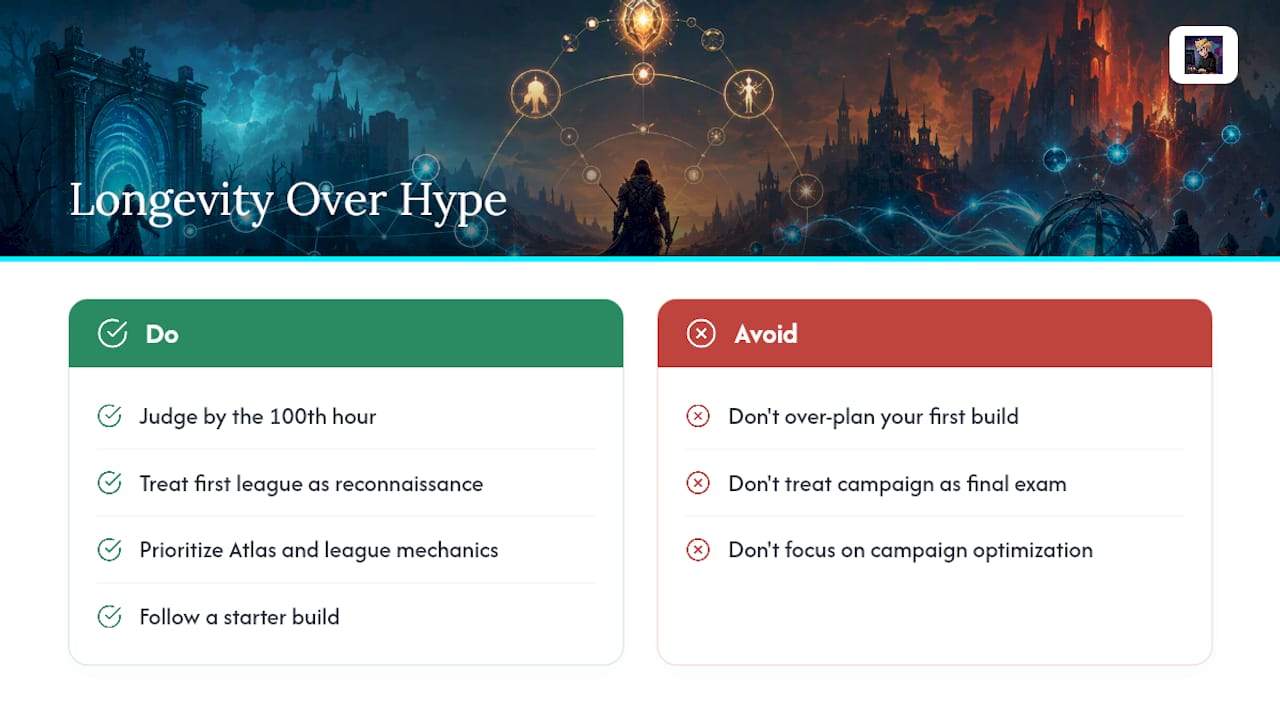
Where we'd push back on typical advice: don't over-plan your first build to the point of paralysis. Yes, follow a starter build, but treat your first league as reconnaissance, not a final exam. You'll learn more from one messy character that dies in maps than from three hours spent reading tree guides.
If you're new, prioritize learning the Atlas and league mechanics over campaign optimization. The campaign is a formality. The systems that actually decide whether you'll still be playing in six months live past it, and that's where your attention should go first.
— QuickWave
Sources
- Path of Exile Review - 2018 - IGN
- Path of Exile on Steam store
- Path of Exile — official game site
- Path of Exile review - GameSpot
- Path of Exile review - PC Gamer
FAQ
Is Path of Exile a good game?
Yes. It's widely regarded as one of the deepest free-to-play action RPGs available, with critics praising its build customization and endgame systems while noting a steep learning curve for newcomers.
Is Path of Exile better than Diablo 4?
They serve different players: Path of Exile offers more granular build customization and a free-to-play model, while Diablo 4 leans toward accessibility and production polish, so better depends on whether you prioritize depth or ease of entry.
Is PoE worth playing right now?
Yes, especially if you enjoy long-term progression and seasonal content, since leagues reset roughly every 13 weeks with new mechanics that keep the endgame from going stale.
Is Path of Exile 1 good, or should I wait for a sequel?
Path of Exile 1 remains a fully supported, content-rich game in its own right, with hundreds of hours of endgame material and ongoing league support, making it worth playing regardless of what comes next.