

If you're playing your main game multiple times a week, the battle pass is almost always worth it. If you're casual, brand new, or unsure you'll stick around, skip it or wait. The deciding factor isn't the price tag, it's whether your playtime and interest in specific rewards can carry you across the finish line before the season ends.
TL;DR:
- A battle pass offers the most value for dedicated players who can complete at least 60 to 75 percent of the tiers, often yielding three to five times its cost in rewards.
- Spending on a pass makes sense primarily if you plan to play multiple times a week and want three or more specific cosmetic items, not for casual or one-season players.
- Partial completion, especially below the 60 percent threshold, significantly reduces the return on investment and can mean paying for content you never access.
- Timing your purchase around the mid-season mark allows better assessment of your actual play rate and reduces the risk of overspending.
- For players who don't meet the playtime threshold, buying specific items directly or setting a seasonal spending limit can maximize value and lower unnecessary expenditure.
Table of Contents
- Is a Battle Pass Worth It? What You're Actually Buying
- The Real Value Math: Hours, Completion Rate, and ROI
- Your 7-Question Battle Pass Checklist
- What Jayplaysgames Sees Across Seasons
- Why the "Just Buy It" Advice Misses the Point
- Get Pass Breakdowns for Your Specific Games
- Quick Tools and Reads for Checking Pass Value
- Sources
- FAQ
Is a Battle Pass Worth It? What You're Actually Buying
A battle pass isn't one thing. It's a bundle of promises tied to a grind, and how good that bundle is depends entirely on what's inside and how it compares to buying items directly from the shop.
Most passes split into a free track and a premium track. The free side usually tosses you a few emotes or a currency crumb. The premium track is where the real value sits: exclusive skins, banners, emotes, and a chunk of the game's premium currency that often offsets part of next season's cost.
Typical pricing runs $7.99 to $12.99 depending on the title, though some premium live-service games push toward $14.99 for bundles with extra tiers included. Here's what a typical premium track hands you:
- Cosmetic skins for characters, weapons, or vehicles, usually the headline reward
- Emotes and sprays that add personality but rarely move the needle on value
- Premium currency refunds, sometimes covering 50 to 100% of what you paid
- Exclusive titles or banners with no shop equivalent, which matters if you collect
- XP boosters that speed up your climb through the tiers
Passes now appear in roughly 60% of top-grossing mobile titles, and that ubiquity is exactly why comparing what you get against what you'd pay in the shop matters more than ever.
The Real Value Math: Hours, Completion Rate, and ROI
Here's the formula that actually matters: (shop value of items earned) ÷ (price paid) = your ROI. A battle pass value calculator shows that a fully completed pass commonly returns 3 to 5 times its price in equivalent item value. Partial completion crashes that number fast, sometimes down to break-even or a loss once you factor in the time spent.
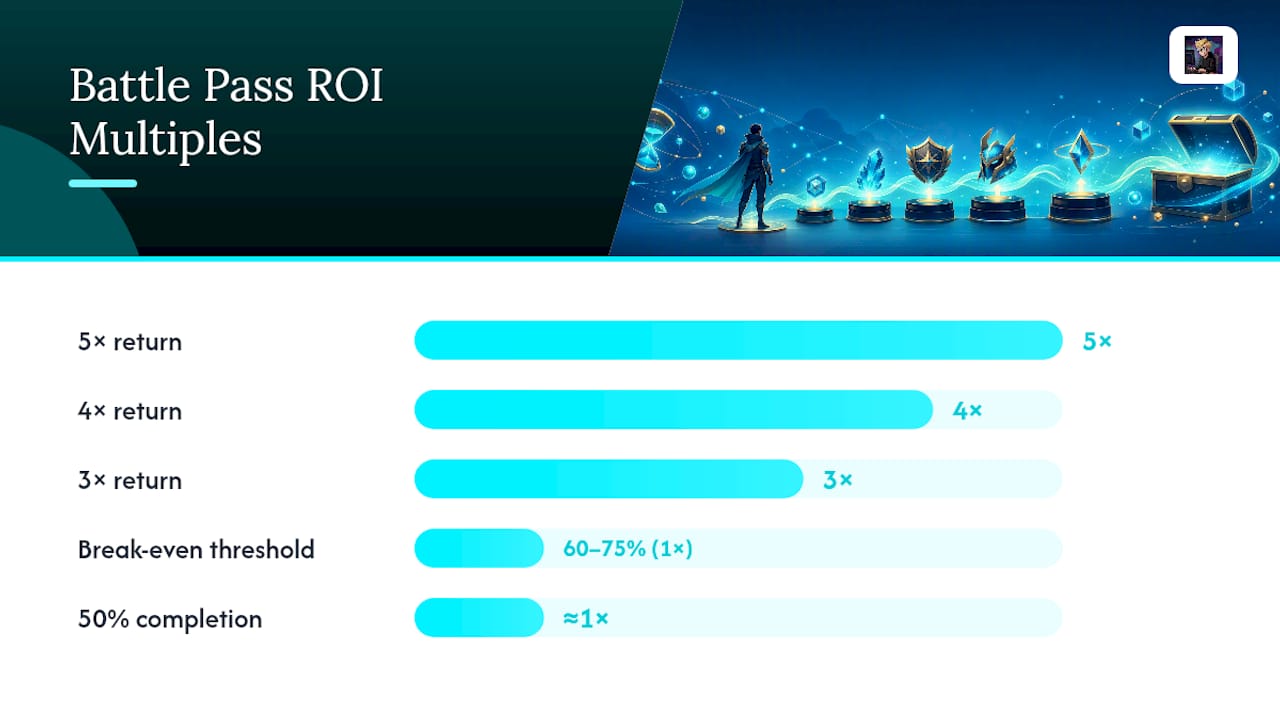
Pro Tip: *Run your own numbers before buying. Add up the shop price of the three or four items you actually want from the pass, then divide by the pass cost.
Completion rate is the hinge everything swings on. Industry calculators frequently cite a 60 to 75% completion threshold as the point where a pass starts paying for itself in practical terms. Below that, you're funding a season pass for content you'll never touch.
Time matters just as much as intent. A common rule of thumb among adult-gamer communities: if you can't reliably commit enough weekly time to that specific game, the time cost usually outweighs the money saved. That's not a hard science, it's a practical filter, but it holds up against how most passes are actually paced.
Developers know this. Most passes front-load easy tiers in the first two weeks, then steepen the grind mid-season, a pattern designed to nudge you toward buying XP boosts or tier skips instead of grinding it out naturally. A League of Legends RP math breakdown shows the pass returns more RP-equivalent value than its cost, provided you actually finish it. The catch, as always, is finishing it.
Picture two outcomes on a $10 pass:
- Full completion: you walk away with $30 to $60 in shop-equivalent items, a clean win.
- 50% completion: your return drops toward the price you paid, sometimes below it once you count the boosts you bought to catch up.
Your 7-Question Battle Pass Checklist
Answer these honestly before you tap "purchase." This isn't about willpower, it's about matching the pass to your actual schedule.
- How many hours a week do you realistically play this specific game? Under 8, be skeptical.
- Are there 3 or more items you genuinely want, not just "would be nice to have"?
- Have you finished a pass in this game before? Past completion predicts future completion better than intentions do.
- Are you already spending on other seasonal content in this game or another one?
- Is your gaming budget for the month already set, or is this an impulse buy?
- Will chasing tiers create stress or FOMO instead of fun? If yes, that's a real cost.
- Can you buy the pass later if early progress looks good? Most games let free-track progress carry over.
If you answered "no" or "unsure" to three or more of these, wait. Waiting until mid-season, once you can see your actual pace, removes most of the risk. Your earned free-track progress typically converts into premium rewards retroactively once you do buy in, so there's rarely a penalty for holding off.
If the pass doesn't fit, alternatives exist: buy the specific items directly, bank your premium currency for something you actually want, set a flat seasonal budget across all your games, or simply sit the season out. None of these are consolation prizes. Direct top-ups suit selective buyers who only want one or two things far better than a pass built for volume players.
What Jayplaysgames Sees Across Seasons
We track pass breakdowns across a rotating slate of titles, and the pattern holds up season after season: passes reward the players who were already going to log in anyway. They rarely convert a lapsed player into a grinder, and they definitely don't manufacture motivation that wasn't there.
The players who get the most value from a battle pass aren't the ones who buy on day one. They're the ones who check their own progress at the two-week mark, see they're already halfway through the free track, and then decide the premium track is worth adding.
Three tips we come back to constantly:
- Wait until mid-season before buying if you're on the fence. You lose nothing and gain real data on your own pace.
- Pick one or two main games to buy passes for, and use direct purchases everywhere else. Spreading pass money across five titles guarantees low completion on most of them.
- Set a spending ceiling for the season before the storefront opens. Decide the number first, not while staring at a countdown timer.
Drop your own pass experiences in the comments. Seeing how other players' completion rates and regrets stack up is often more useful than any calculator.
Why the "Just Buy It" Advice Misses the Point
Most battle pass advice treats the purchase like a binary: worth it or a scam. That framing is lazy, and it ignores the one variable that actually predicts outcomes: your own playtime pattern over the last month, not this season's hype trailer.
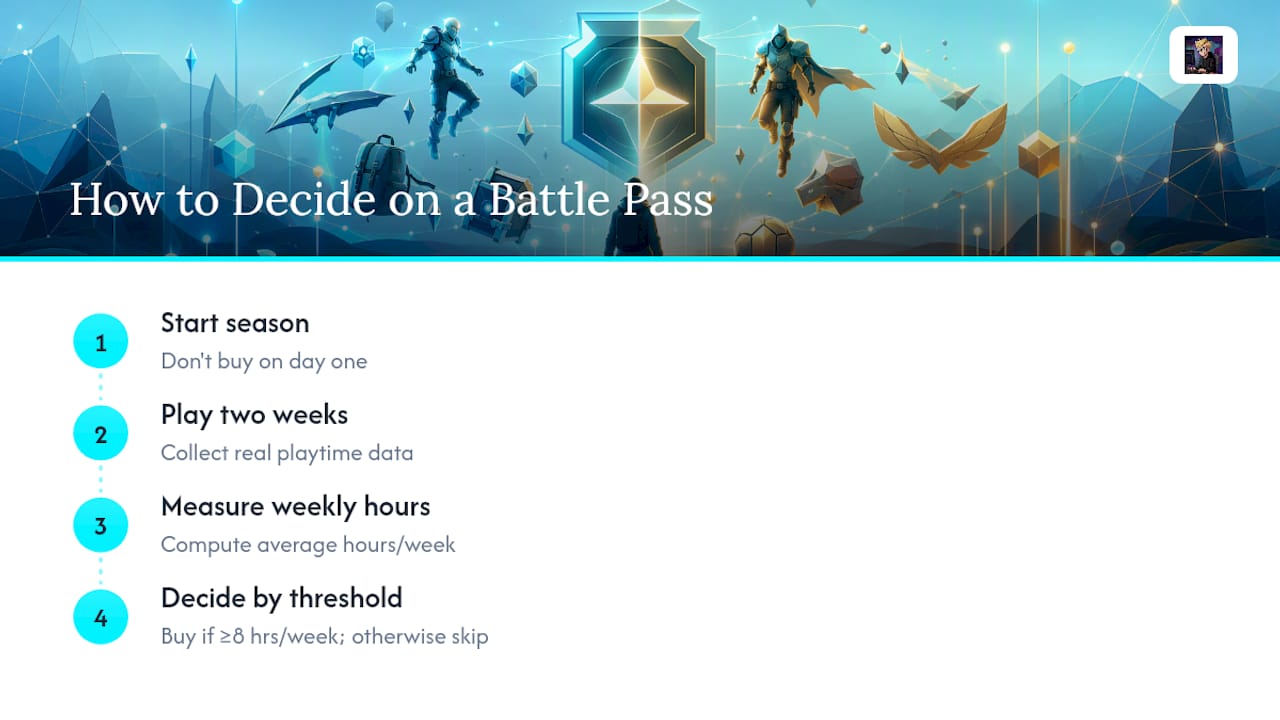
The conventional wisdom (buy early to lock in the discount, or never buy because "it's all just a grind trap") both miss the same thing. Passes aren't good or bad in the abstract. They're a bet on your future hours, and most players are terrible at forecasting their own future hours. That's why the 8+ hours a week threshold matters more than any cosmetic preview.
What we'd prioritize differently: stop evaluating the pass on day one. Evaluate your own play log two weeks into the season, then decide. The completion rate math doesn't lie, but it only works if you feed it real data instead of optimism. A checklist beats a vibe every time money's involved.
— QuickWave
Get Pass Breakdowns for Your Specific Games
Generic rules of thumb only go so far. Every title paces its grind differently, prices its tiers differently, and rewards different kinds of players, so the smartest move is checking a pass-by-pass breakdown for the game you actually play.
Jayplaysgames runs dedicated guides and reward analyses across our games hub, covering everything from progression pacing to whether a specific season's rewards justify the cost for your playstyle. If you're grinding a title like RAID: Shadow Legends, our Raid Shadow Legends page breaks down seasonal value alongside our farming and gear guides, so you're not guessing based on a generic hours-per-week rule. Check the guide for your specific game before you commit your currency this season.
Quick Tools and Reads for Checking Pass Value
The Battle Pass Value Calculator lets you plug in completion rate and price to see your real ROI. For definitions and mechanic history, Wikipedia's battle pass overview is a solid neutral starting point. Our own games hub covers title-specific breakdowns.
Sources
- Battle Pass Value Calculator | CalcBee
- Is a Mobile Battle Pass Worth It in 2026? (A Brutally Honest Breakdown) - Itembase
- Battle Pass vs. Direct Top-Ups: Which Spending Style Fits You Best? | Codashop Blog US
- Is the LoL Battle Pass Worth It? RP Math Breakdown
FAQ
Is a Battlefield 6 Battle Pass Worth It?
It's worth it under the same rule as any other title: if you're playing several times a week and want specific cosmetics, yes. If you're casual, wait until mid-season to see your actual completion pace before buying.
Should I Get the Battle Pass This Season?
Buy it if you can realistically hit 8+ hours a week in that game and want three or more of the included items. Otherwise, wait or skip, since partial completion often drags your return below what you paid.
What Fortnite Skins Cost $800?
Extremely rare or bundle-exclusive cosmetic sets, particularly licensed collaboration skins sold as premium bundles rather than through the standard battle pass, have carried price tags in that range in the item shop; these are separate from standard battle pass rewards, which cost far less per item.
What Is the Point of a Battle Pass?
Battle passes give developers predictable recurring revenue while giving players a structured reward track for time already spent in the game. For players, the point is converting playtime into cosmetics and currency at a better rate than buying each item individually, but only if you finish the track.
Do Battle Passes Pay for Themselves?
Yes, if you complete 60 to 75% or more of the tiers, a completed pass commonly returns 3 to 5 times its price in equivalent shop value. Below that completion range, the pass often breaks even or loses value against a direct purchase.